Tall matrices: stacking measurements
Each row of a tall matrix can encode one sensor reading or one linear constraint. When $m\gt n$, exact equality $A\mathbf{x}=\mathbf{b}$ is impossible for generic $\mathbf{b}$ because the column space lives in at most $n$ dimensions inside $\mathbb{R}^m$ .
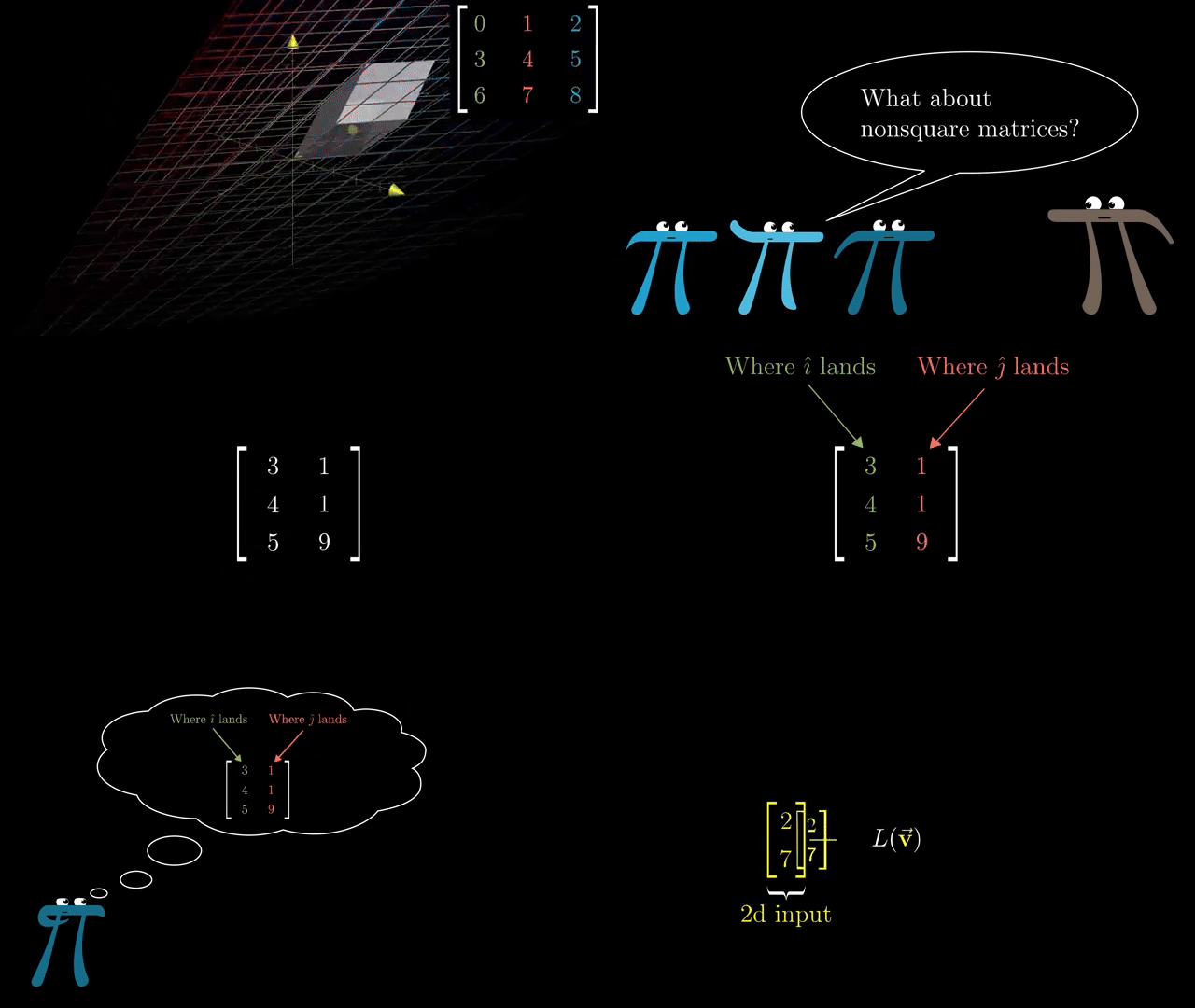
Full column rank tall matrices are injective: only $\mathbf{0}$ maps to $\mathbf{0}$. They still fail to be surjective onto $\mathbb{R}^m$ when $m\gt n$: you cannot fill a five-dimensional ambient space with only two independent column directions.
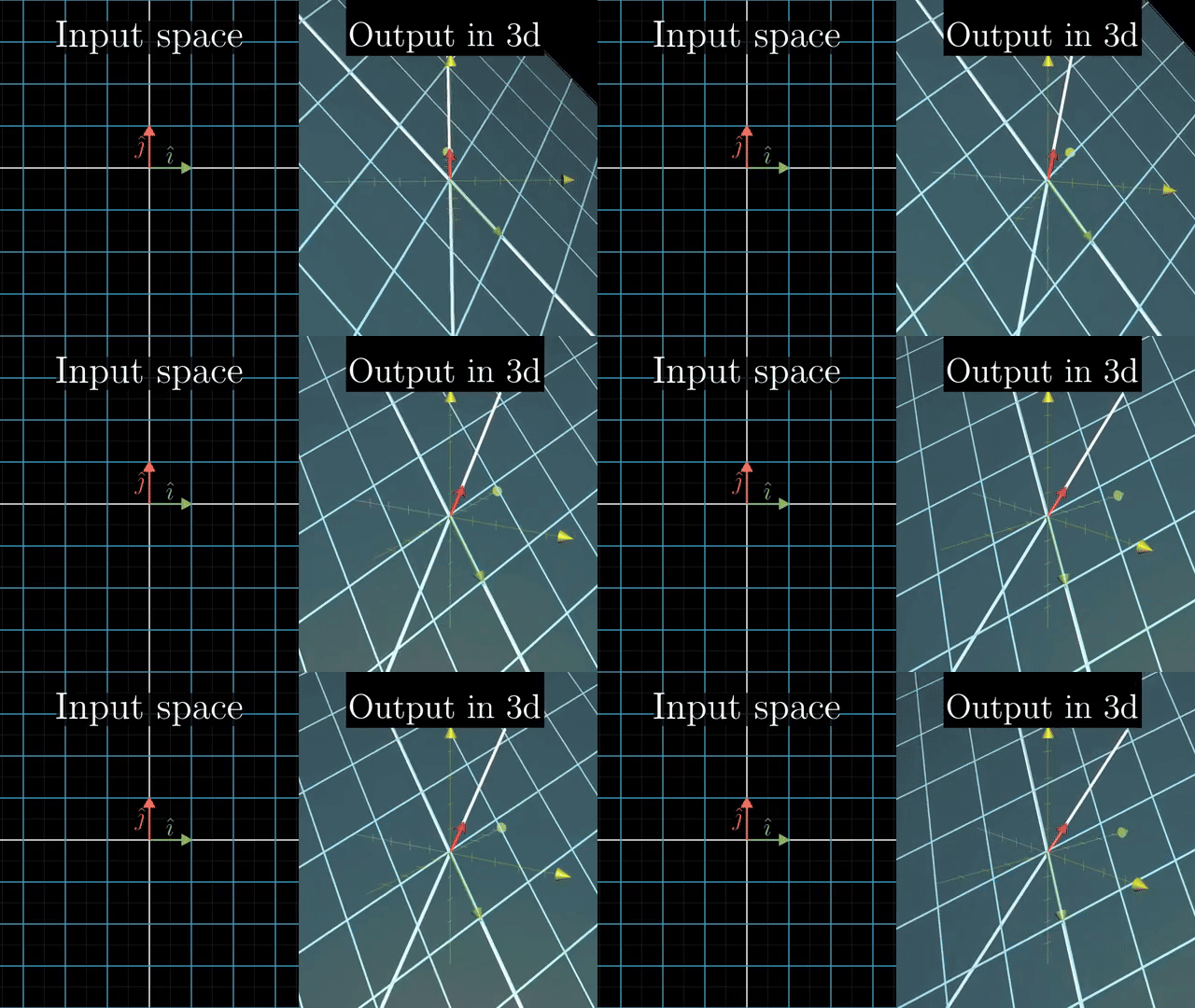
Least squares replaces unsolvable systems by minimizing $\|A\mathbf{x}-\mathbf{b}\|$, which geometrically projects $\mathbf{b}$ onto the column space. That preview connects tall matrices to statistics and engineering fits before formal orthogonal projection chapters. A $5\times 2$ matrix can be injective on $\mathbb{R}^2$ but its image is at most a plane inside $\mathbb{R}^5$, so most right-hand sides $\mathbf{b}$ are unreachable with exact equality. Least squares minimizes $\|A\mathbf{x}-\mathbf{b}\|$, projecting $\mathbf{b}$ onto the column space . Typical random tall matrices have full column rank until $m\lt n$. Surjectivity onto $\mathbb{R}^m$ is impossible when $m\gt n$ because the image has dimension at most $n$. Least squares is the standard overdetermined response.
Related cards
Video Content
Tasks
Card Info
- Topic: Mathematics
- Difficulty: Intermediate
- Completed: 0 users
Creator
