Shape tells codomain and domain sizes first
An $m\times n$ matrix defines a linear map $A:\mathbb{R}^n\to\mathbb{R}^m$. Rows count outputs; columns count inputs . Tall matrices ($m\gt n$) pack more measurement rows than unknown columns; wide matrices ($m\lt n$) have more unknowns than equations.
Shape is not rank: two matrices can share the same rank but differ in how they embed or project between ambient spaces. A $3\times 2$ matrix with independent columns maps $\mathbb{R}^2$ injectively into $\mathbb{R}^3$, but it cannot cover all of $\mathbb{R}^3$ because the image is at most two-dimensional.

A wide $2\times 3$ matrix cannot be injective: rank-nullity forces kernel dimension at least $3-2=1$ when rank is at most $2$. A $1\times n$ row matrix computes one linear measurement, the dot product of $\mathbf{x}$ with that row.
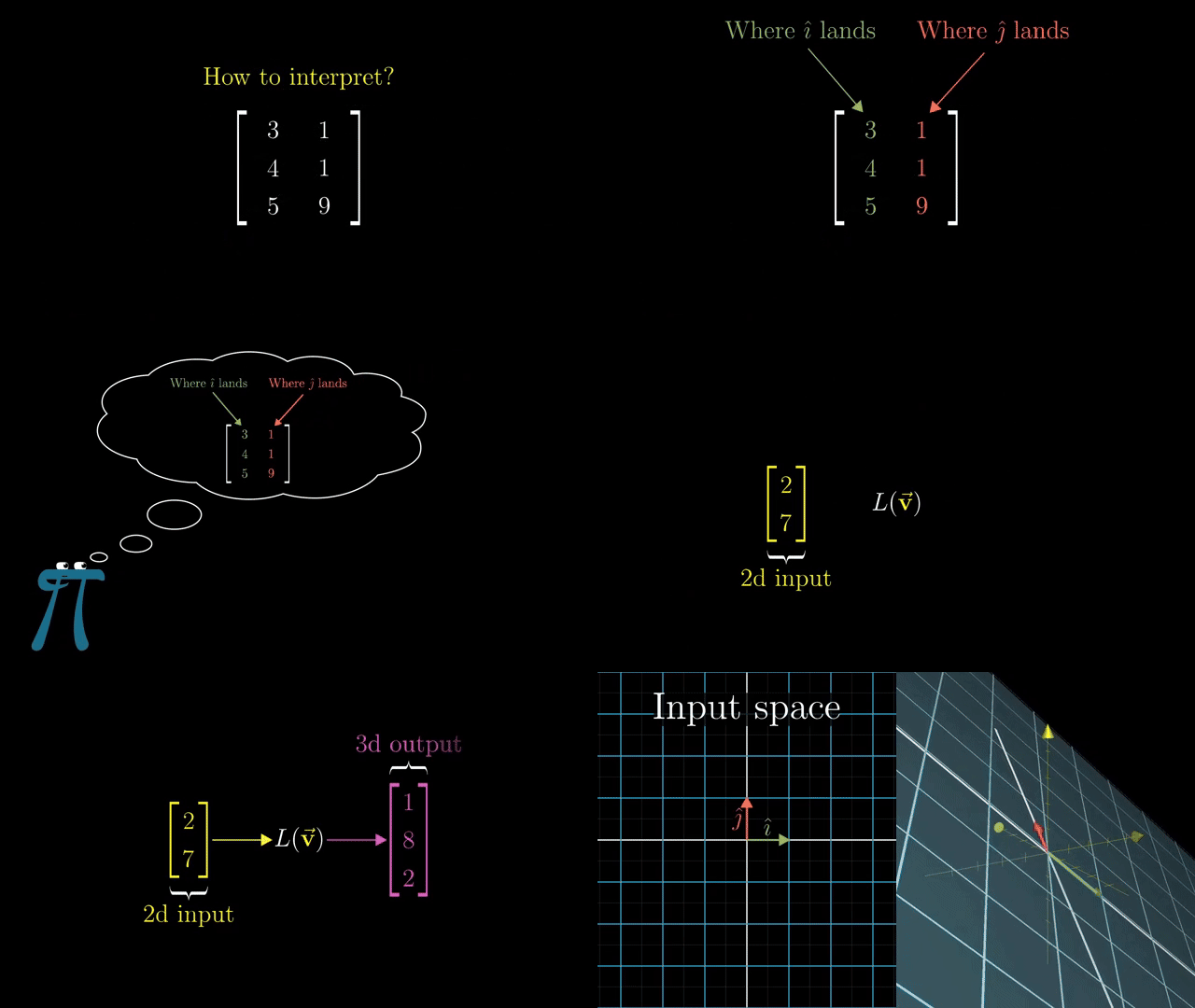
Composition obeys $\mathrm{rank}(AB)\le\min(\mathrm{rank}A,\mathrm{rank}B)$: intrinsic dimension cannot increase when maps are chained. Read $m\times n$ as "$m$ outputs, $n$ inputs" before any calculation; shape errors are the most common mistake with nonsquare matrices. Independent columns in a $3\times 2$ matrix mean injective $\mathbb{R}^2\to\mathbb{R}^3$ .
Related cards
Video Content
Tasks
Card Info
- Topic: Mathematics
- Difficulty: Intermediate
- Completed: 0 users
Creator
