Row operations and Gaussian intuition
Row reduction tracks determinant systematically . Swapping rows flips the sign. Multiplying a row by $c$ multiplies the determinant by $c$. Adding a multiple of one row to another preserves the determinant, which is why elimination steps that only use that move are safe for determinant bookkeeping.
Triangular matrices are easy: the determinant is the product of diagonal entries when the matrix is upper or lower triangular. That is the computational payoff after reducing to a triangular form while recording sign changes from swaps and scalings.
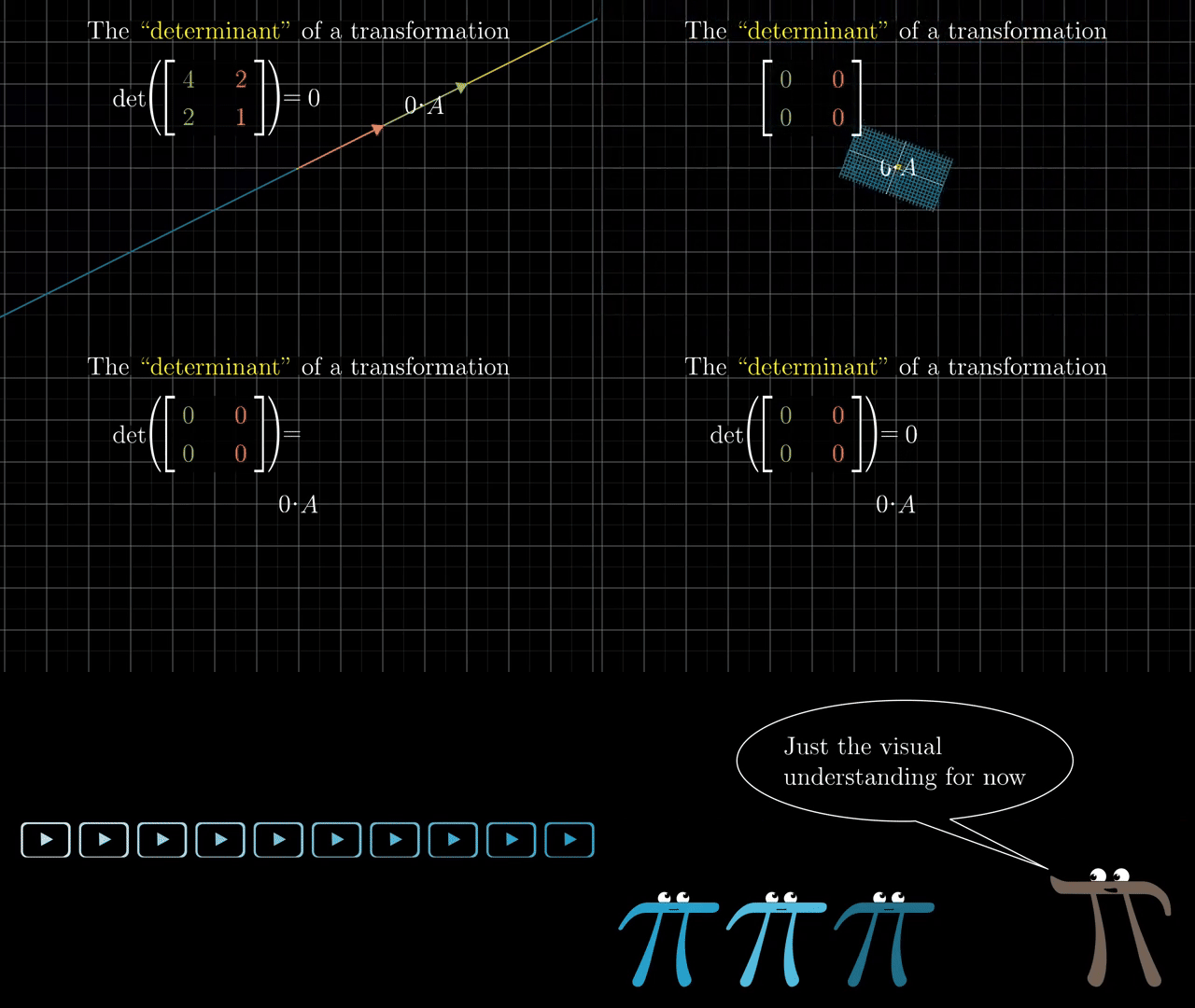
Transpose symmetry $\det(A^T)=\det(A)$ says row pictures and column pictures agree on volume scale. Numerically, a pivot near zero during elimination signals near singularity even if the determinant is formally nonzero: tiny pivots amplify errors in solves. Triangular matrices make the product rule on the diagonal immediate once elimination finishes .

Very small $\lvert\det\rvert$ means solving $A\mathbf{x}=\mathbf{b}$ is sensitive to noise in $\mathbf{b}$ unless you precondition or regularize. Geometry and numerics meet here. Row swaps during elimination flip the sign because they correspond to odd permutations of basis order; track how many swaps you perform when reducing to triangular form.
Related cards
Video Content
Tasks
Card Info
- Topic: Mathematics
- Difficulty: Intermediate
- Completed: 0 users
Creator
