Determinant as volume scale factor for the column brick
Grant Sanderson's geometric definition: for an $n\times n$ matrix $A$, the absolute value $\lvert\det A\rvert$ measures how much $A$ scales $n$-dimensional volume . In $\mathbb{R}^2$ the columns span a parallelogram; in $\mathbb{R}^3$ they span a parallelepiped. The determinant packages that volume relative to the unit brick built from the standard basis.
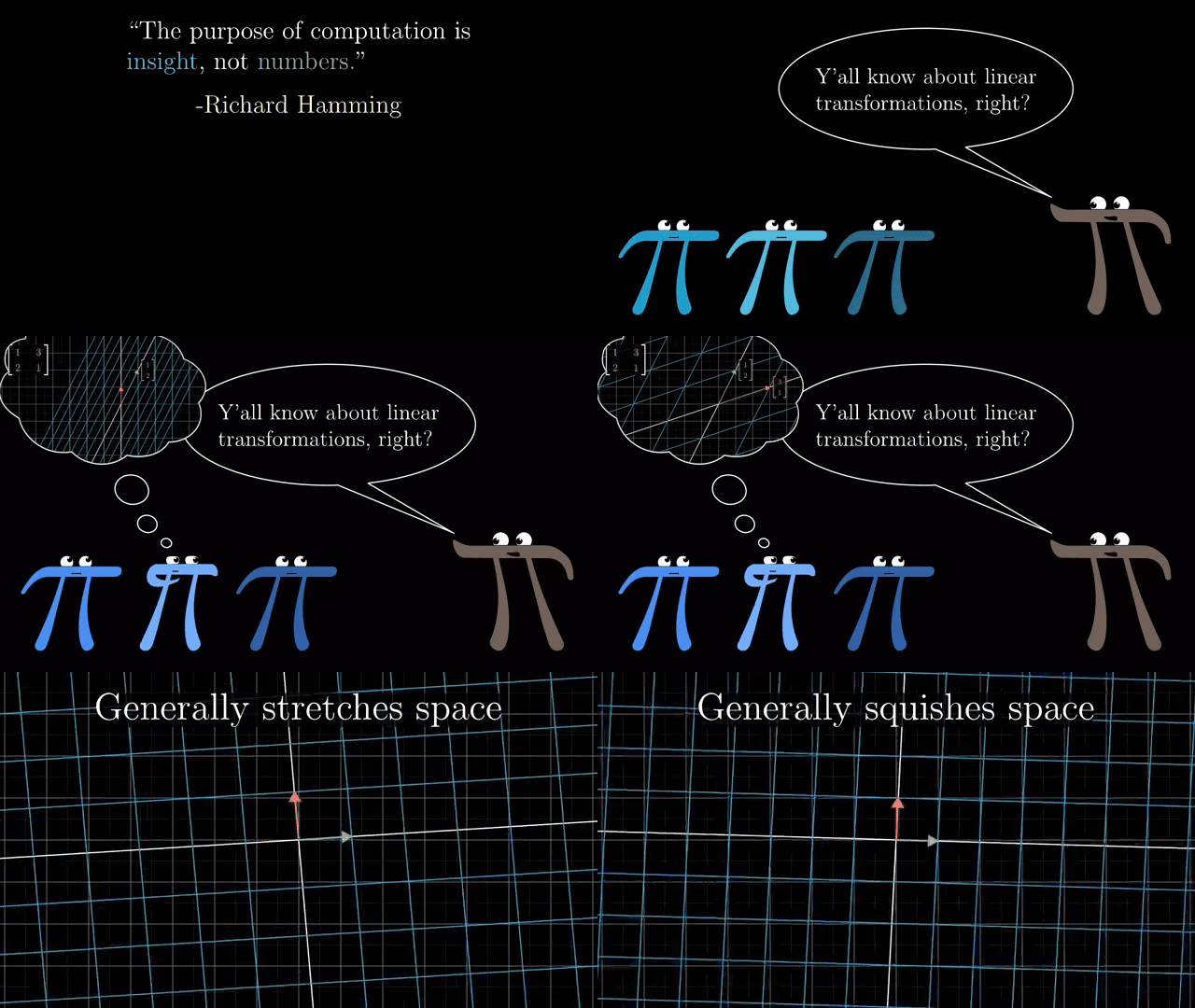
If $\det(A)=0$, the columns are linearly dependent and positive volume collapses: the map squashes space onto something lower-dimensional. If $\det(I)=1$, the identity leaves volume unchanged. Multiplicativity $\det(AB)=\det(A)\det(B)$ says volume scale factors compound under composition, exactly as in the three-dimensional preview.
Sign is separate from magnitude: a negative determinant reverses orientation while still reporting a volume scale via the absolute value. Keep both pieces; physics-style bookkeeping often tracks whether a transformation flips handedness.
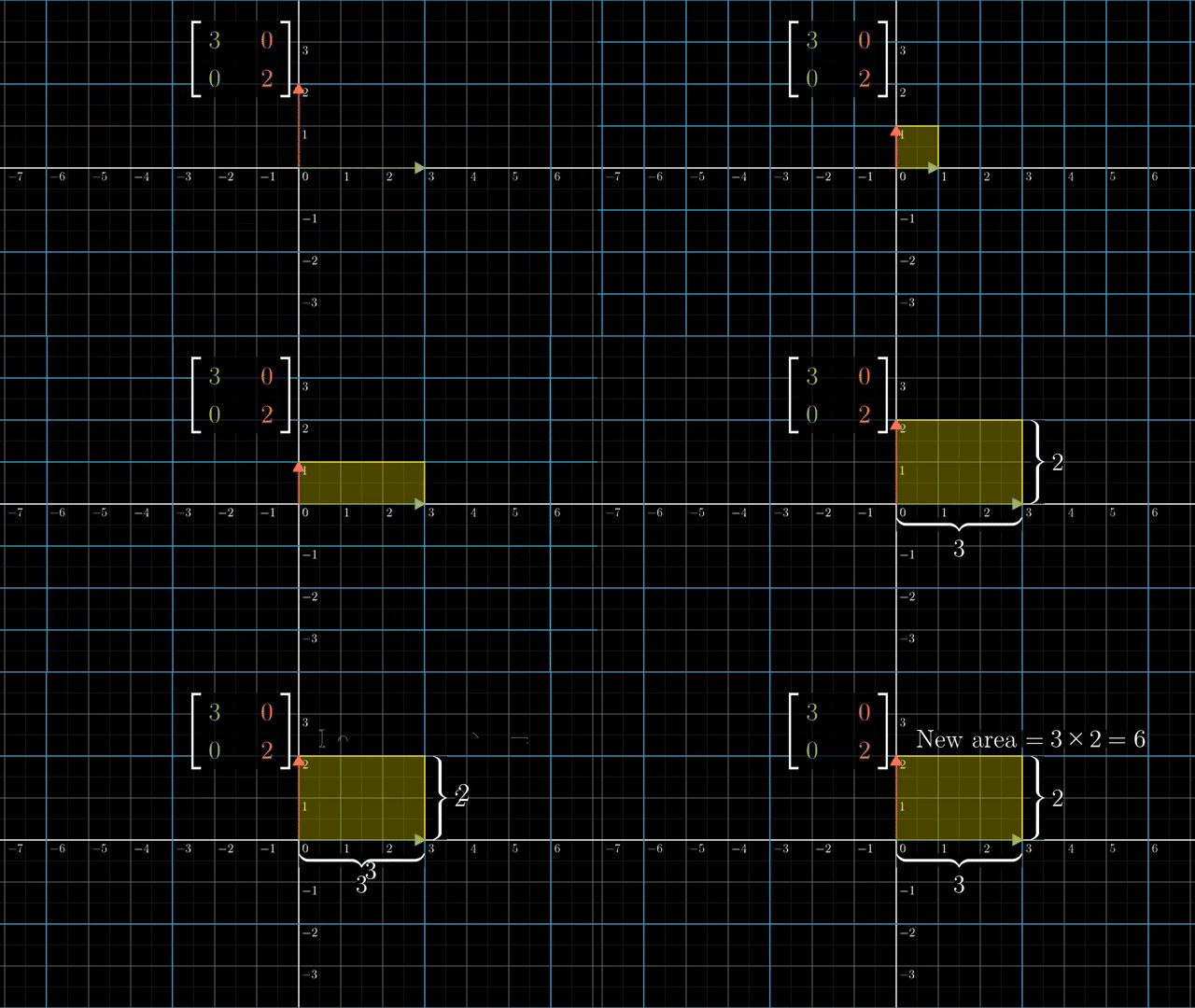
Interpret $\lvert\det A\rvert\lt 1$ on $\mathbb{R}^3$ as shrinking typical solids toward smaller images inside the range, while $\lvert\det A\rvert\gt 1$ expands them. Neither statement requires expanding minors first. In $\mathbb{R}^2$, the parallelogram spanned by columns $(a,c)$ and $(b,d)$ has area $\lvert ad-bc\rvert$; the area story comes before any Laplace expansion.
Related cards
Video Content
Tasks
Card Info
- Topic: Mathematics
- Difficulty: Intermediate
- Completed: 0 users
Creator
