Chapter stop: you are ready for determinant as volume scale
You now have a three-dimensional vocabulary for linear maps: columns as moved basis vectors, rank as how much dimension survives, orientation as sign data waiting for a magnitude . the next chapter names that magnitude: $\lvert\det A\rvert$ is how much $n$-dimensional volume scales, and the sign of $\det A$ records orientation reversal.
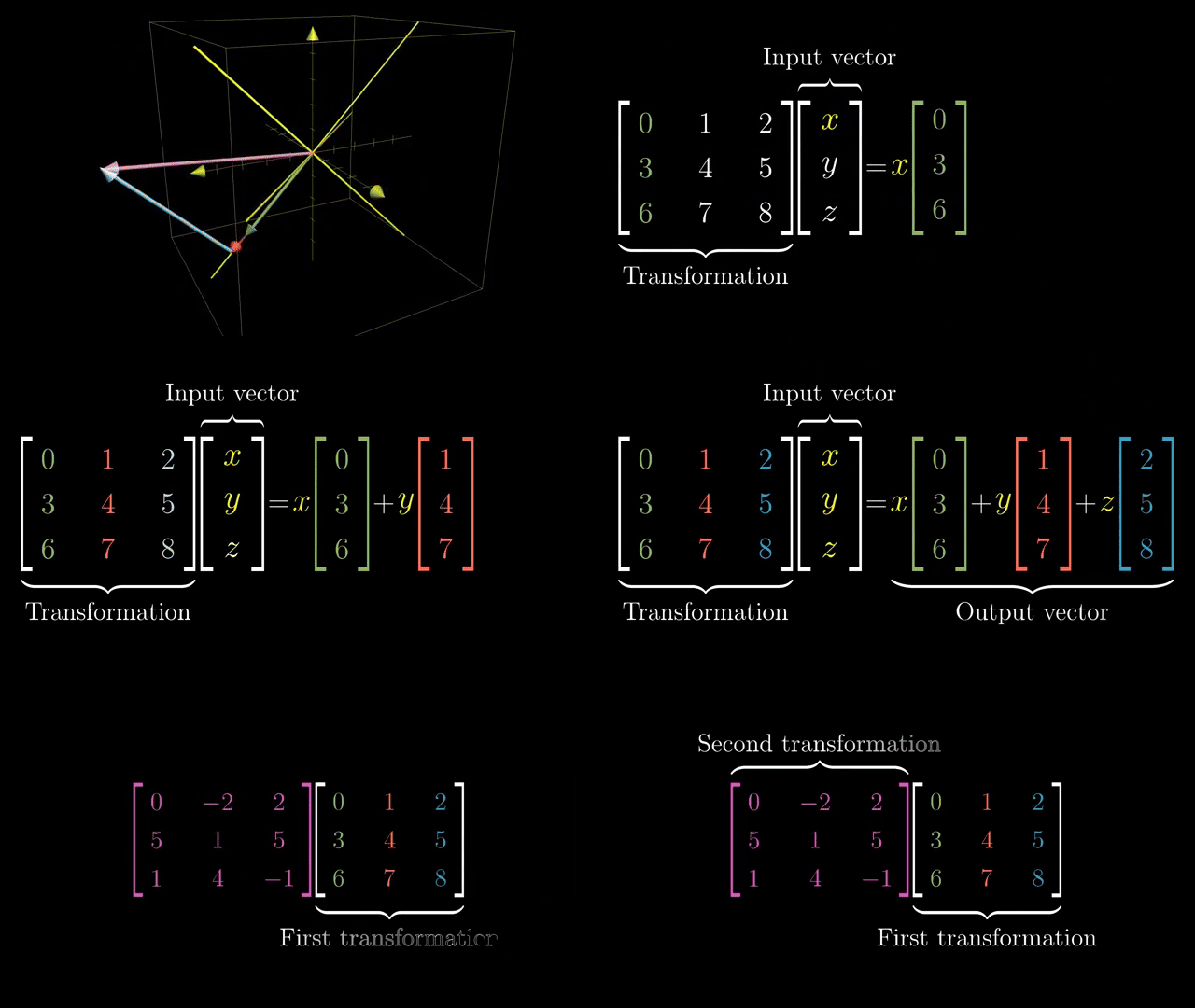
Invertible $3\times 3$ maps are exactly those with independent columns, which is the same as nonzero determinant for square matrices. Dependent columns flatten the unit cube to a flat slab, so volume goes to zero. If $\det A=2$, a small ball around the origin grows to roughly twice the radius cubed in volume scale (factor $2$ on volume in $\mathbb{R}^3$). If $\det A=-2$, volume still scales by $2$ but orientation reverses.
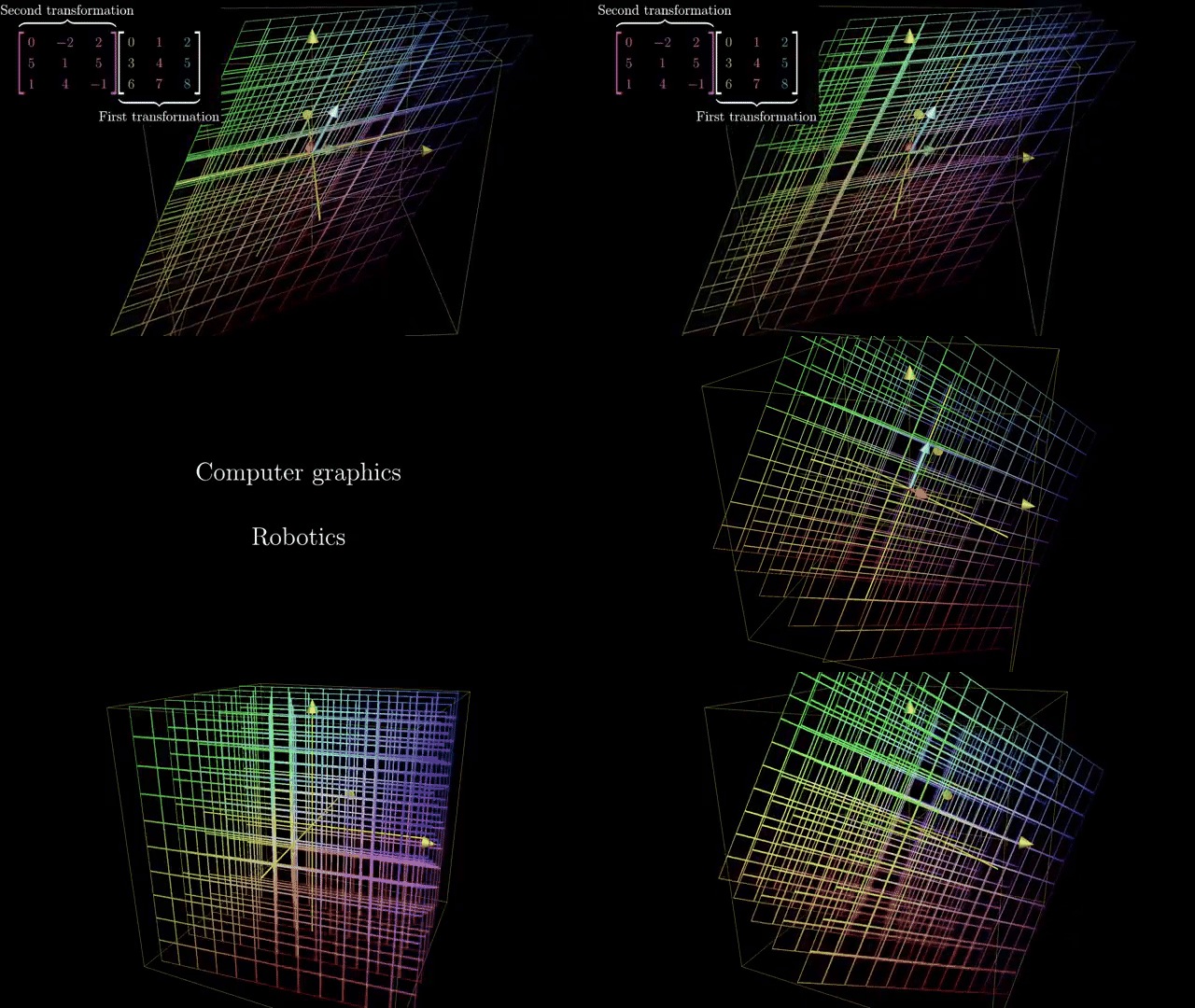
Product rule preview: $\det(AB)=\det(A)\det(B)$ matches the composition story for volume. Keep both absolute value and sign in mind: physics bookkeeping often cares whether orientation flipped, not only how large the region became. Chapter 6 will define $\det$ as the volume scale of the column brick; you already know what rank collapse and reflections look like in three dimensions .
Related cards
Video Content
Tasks
Card Info
- Topic: Mathematics
- Difficulty: Intermediate
- Completed: 0 users
Creator
