Rank in three dimensions: lines, planes, volumes
Rank counts how many independent directions survive in the output. Rank 1 collapses all of $\mathbb{R}^3$ onto a line through the origin. Rank 2 squashes to a plane. Rank 3 maps with a genuine volumetric image: a parallelepiped with nonzero volume .
Picture dependent columns as forcing two different input directions to share the same output direction. Algebraically, that is linear dependence among columns; geometrically, the brick flattens. Example: if every column of $A$ is a multiple of $(1,2,3)$, the image is the line through that vector; a unit cube smears onto a segment.
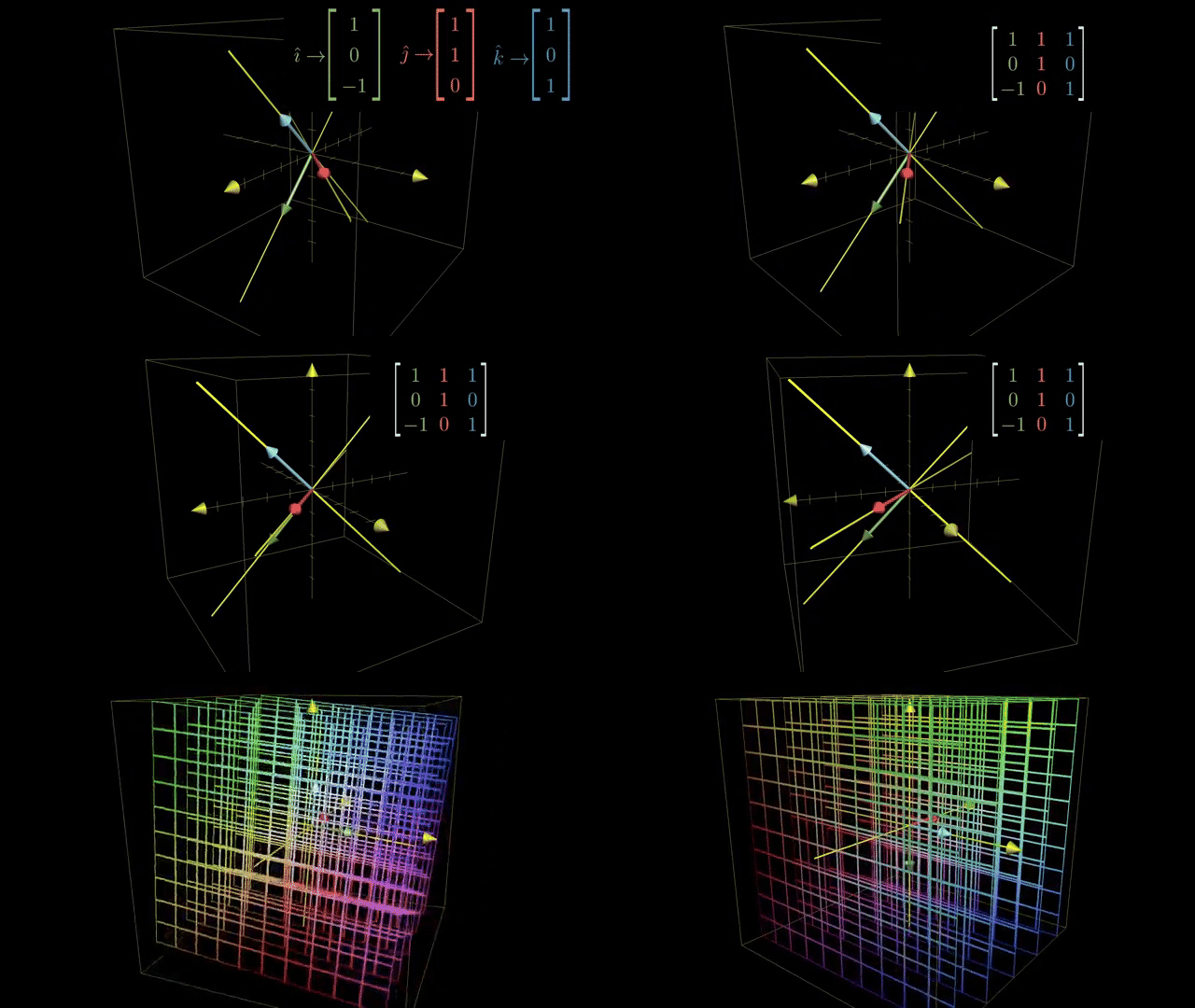
Kernel dimension pairs with rank by rank-nullity: for a map $\mathbb{R}^3\to\mathbb{R}^3$, $\mathrm{rank}(A)+\mathrm{nullity}(A)=3$. Rank 2 therefore leaves a one-dimensional null space: inputs that disappear.
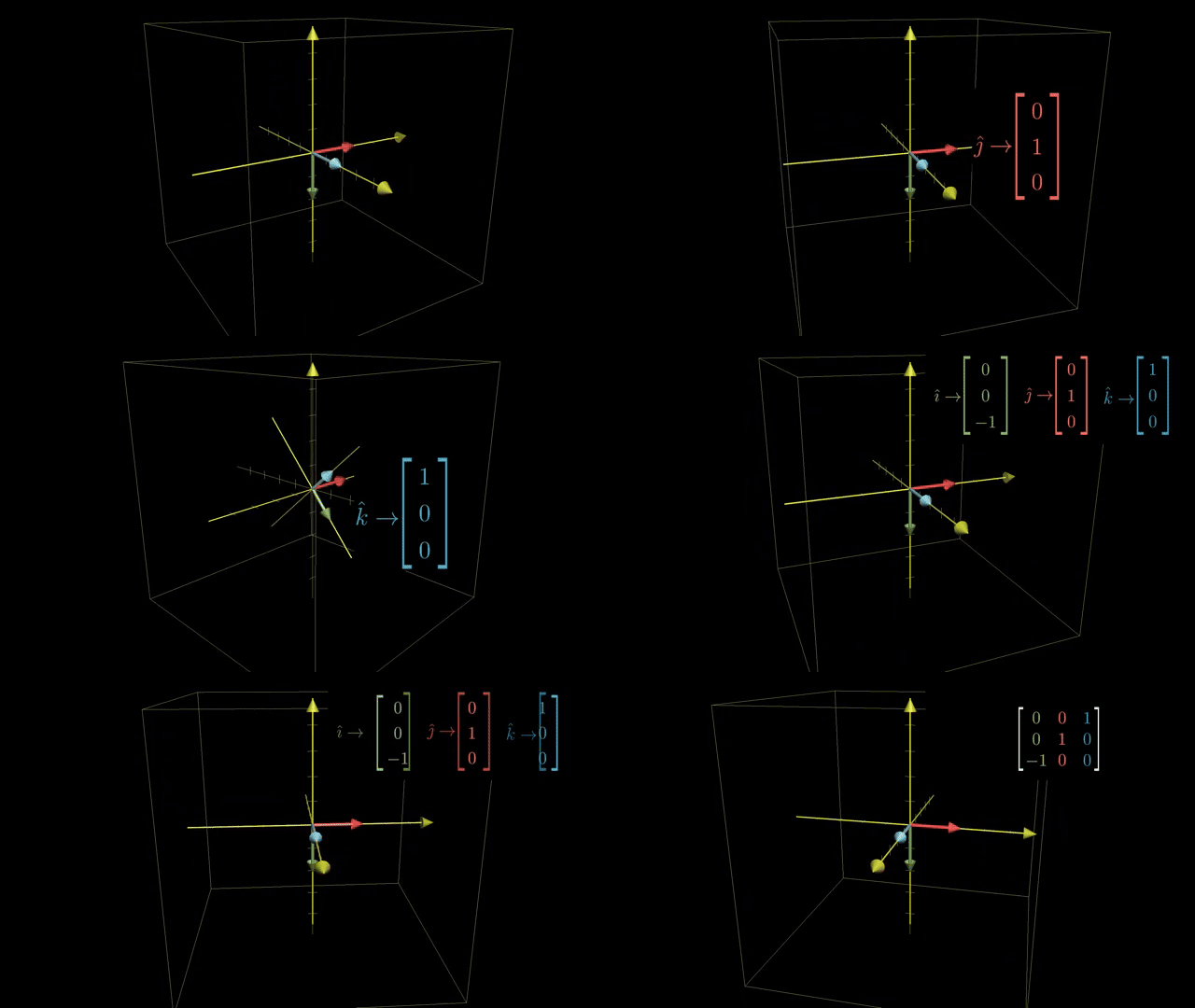
Almost-singular maps (rank 2.99 numerically) amplify noise along the nearly collapsed direction. That is separate from the exact algebra but explains why engineers care about rank in simulation and least squares even before formal eigenvalue theory. A $3\times 3$ matrix with two parallel columns has rank at most $2$; a cube maps to a flat slab, foreshadowing $\det=0$ .
Related cards
Video Content
Tasks
Card Info
- Topic: Mathematics
- Difficulty: Intermediate
- Completed: 0 users
Creator
