Orientation: right-hand rule survives or flips
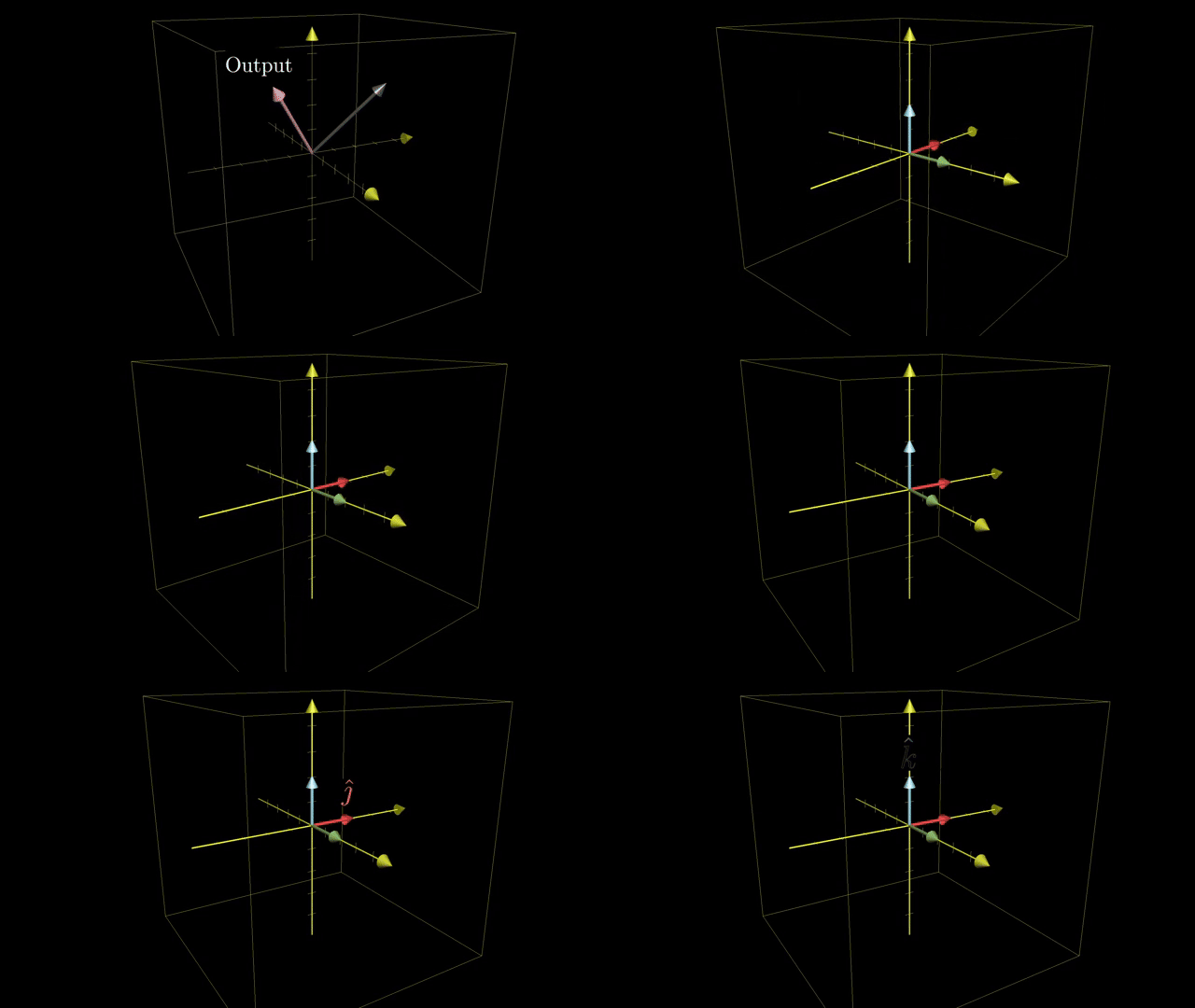
Orientation is about whether a small right-handed tripod of vectors keeps that handedness after the map . In $\mathbb{R}^3$ you can test it with the right-hand rule on $\hat{\mathbf{i}},\hat{\mathbf{j}},\hat{\mathbf{k}}$ and their images.
Maps with positive determinant preserve orientation: a small solid region keeps a positive signed volume sense. Maps with negative determinant reverse it, as reflections through a plane through the origin do. The sign does not tell you how much volume scales; that is $\lvert\det A\rvert$, developed next chapter. A rotation about the $z$-axis preserves orientation; reflecting the $x$-coordinate while fixing $y$ and $z$ flips it.
Composition multiplies determinants because volume scale factors compound: if $B$ scales volume by $2$ and $A$ scales by $3$, then $AB$ scales by $6$. If one factor reverses orientation and the other preserves it, the product reverses orientation.
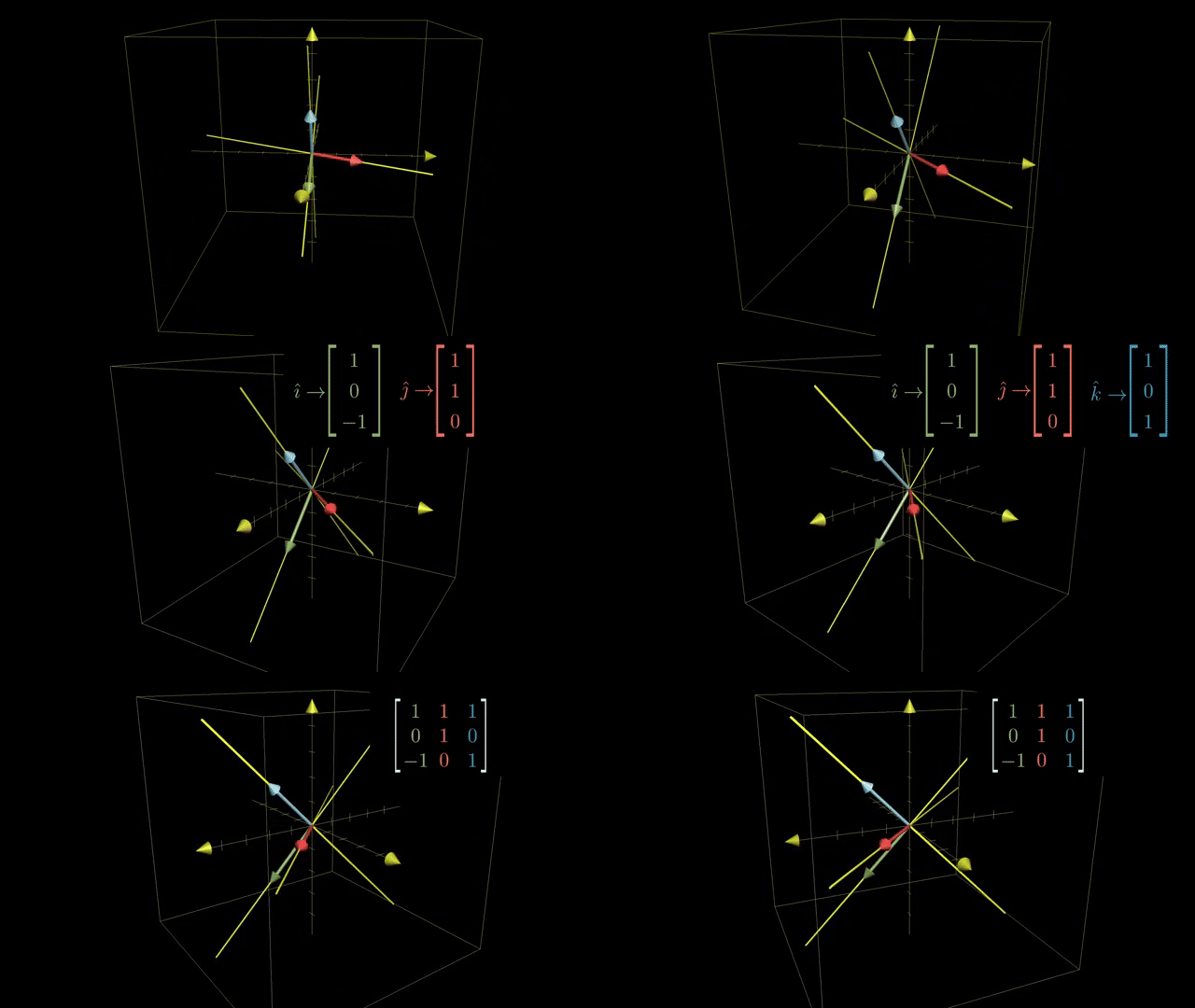
Physical conventions (torque, magnetism, cross-product direction) bake in a handedness choice. When you change coordinates with a matrix that flips orientation, you must track that sign or formulas pick up a minus unexpectedly. The right-hand rule on $\hat{\mathbf{i}},\hat{\mathbf{j}},\hat{\mathbf{k}}$ is the standard orientation anchor in this series .
Related cards
Video Content
Tasks
Card Info
- Topic: Mathematics
- Difficulty: Intermediate
- Completed: 0 users
Creator
