Columns still list where $\hat{\mathbf{i}},\hat{\mathbf{j}},\hat{\mathbf{k}}$ land
The column recipe from two dimensions survives unchanged: column one is $A\hat{\mathbf{i}}$, column two is $A\hat{\mathbf{j}}$, column three is $A\hat{\mathbf{k}}$ . Each column is an arrow in output space telling you how a unit basis vector is stretched, rotated, and possibly reflected.
Matrix multiplication composes maps exactly as before: if $B$ then $A$ acts first on an input $\mathbf{x}$, the product $AB$ means apply $B$, then $A$. Order still matters; in graphics you feel that when a local rotation is applied before a global one versus after.
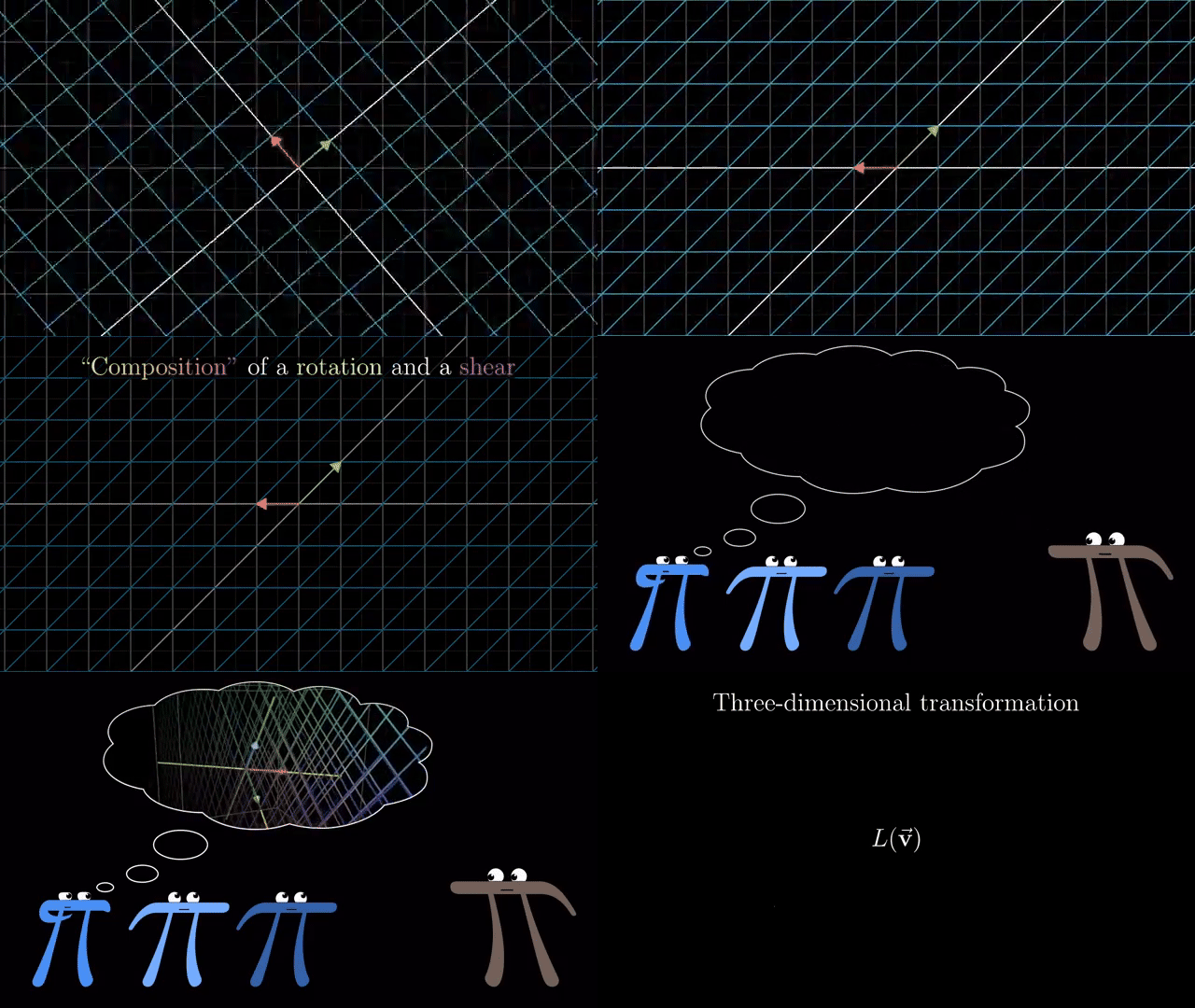
Numerical habit: write small $3\times 3$ examples with explicit brackets so you never confuse row lists with columns. Right-handed bases matter: when the three output columns stay right-handed, orientation is preserved; when one column flips the handedness of the triple, determinant sign will go negative. Try mentally tracking $\hat{\mathbf{i}}\mapsto$ col 1, $\hat{\mathbf{j}}\mapsto$ col 2, $\hat{\mathbf{k}}\mapsto$ col 3 before multiplying matrices on paper.
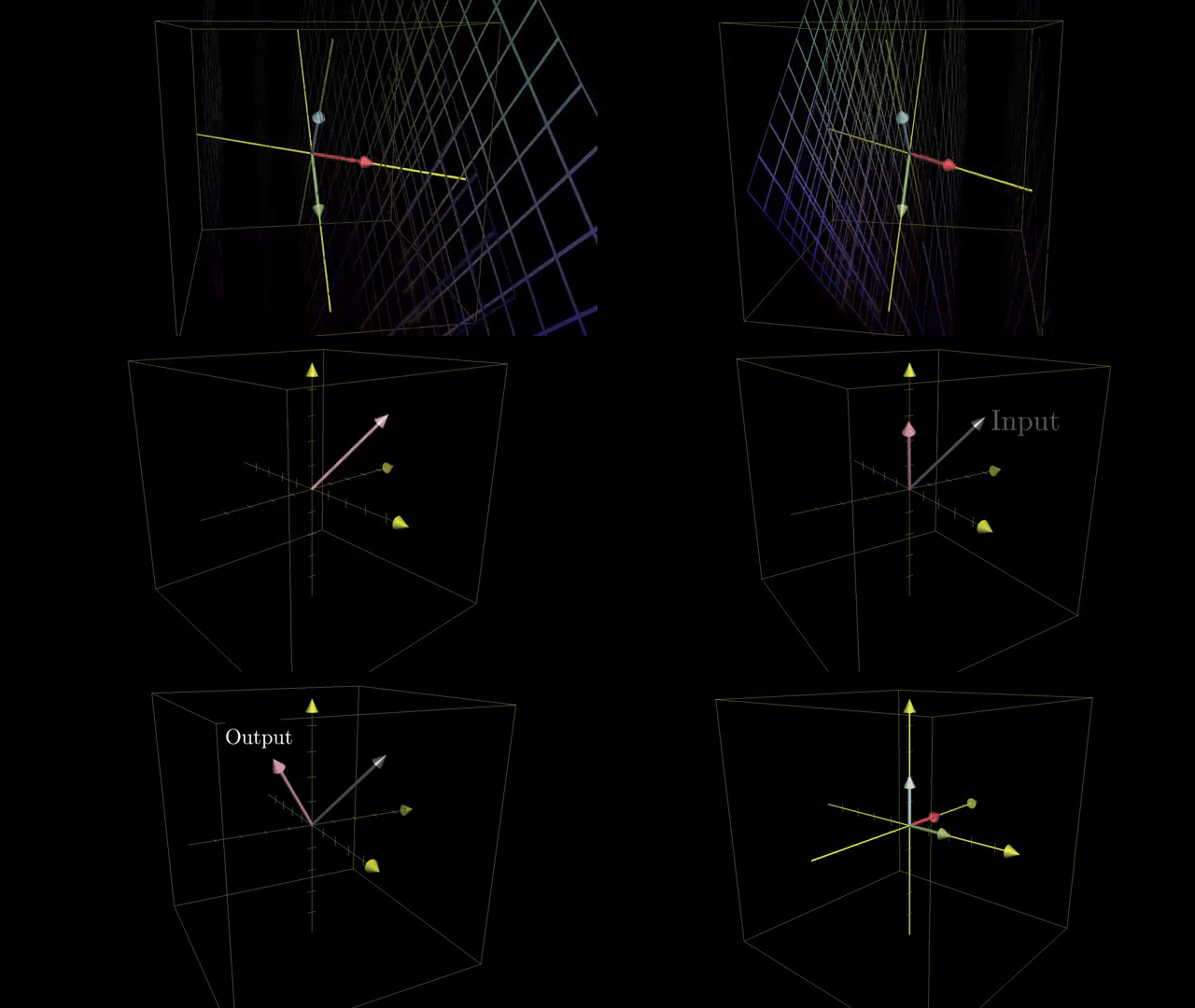
Edge case: if two columns coincide, the map cannot be invertible because two independent input directions are forced into the same output direction. That is rank drop in three dimensions, visible as a flattened parallelepiped rather than a solid brick.
Related cards
Video Content
Tasks
Card Info
- Topic: Mathematics
- Difficulty: Intermediate
- Completed: 0 users
Creator
