Grids become parallelepiped lattices, still linear
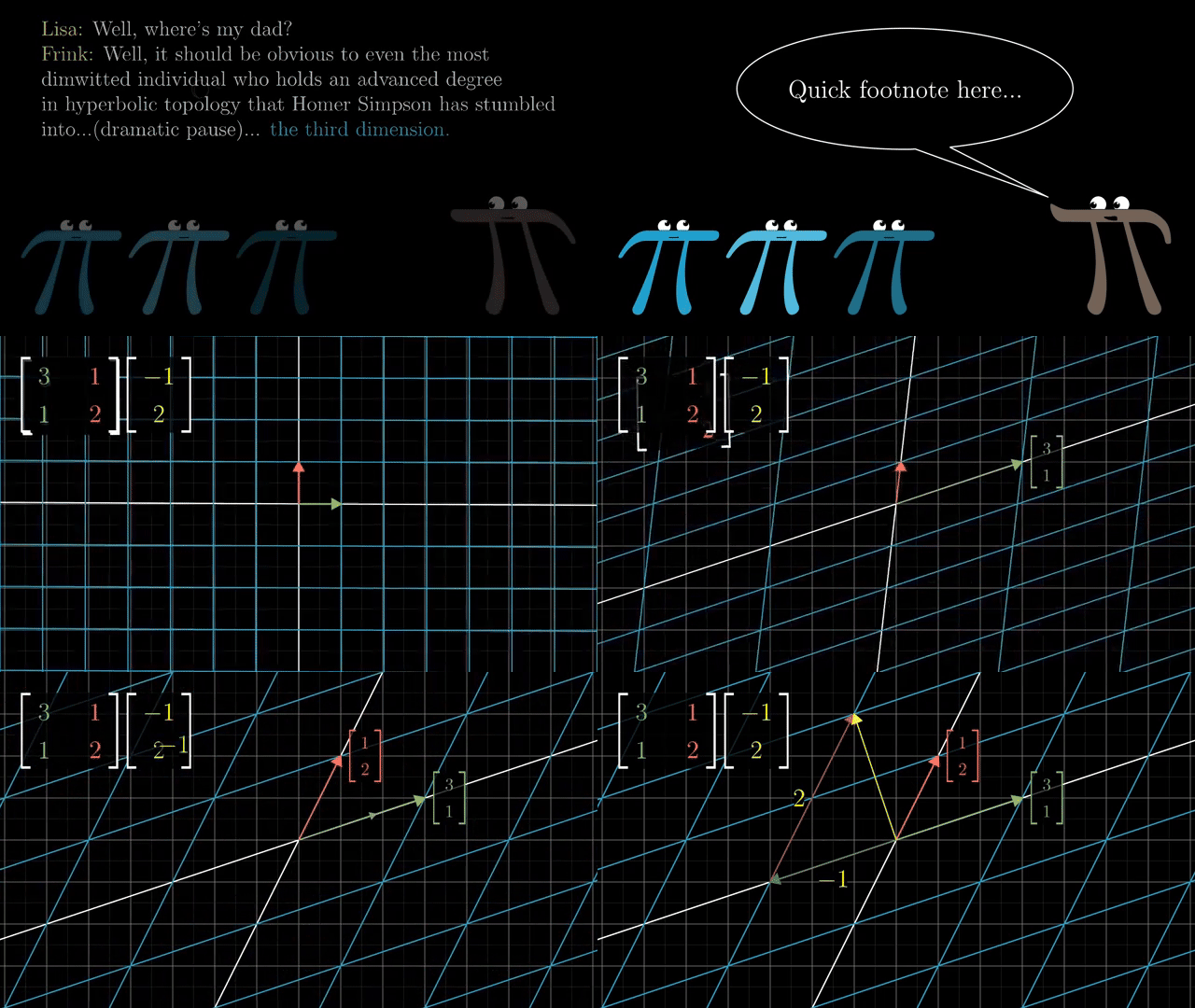
Chapter 4 made two-dimensional grids bend into parallelogram lattices while preserving the linear rules: the origin stays fixed, lines through $\mathbf{0}$ map to lines, and evenly spaced parallel families stay parallel and evenly spaced . In three dimensions the picture upgrades from tiles to parallelepiped bricks built from three independent edge directions.
A linear map $T:\mathbb{R}^3\to\mathbb{R}^3$ still cannot curve space: planes through the origin become planes, and a cube centered at the origin becomes a parallelepiped whose faces come from pushing the three basis directions through $T$. Shears that fix the $xy$-plane while sliding $z$ are linear because they respect sums and scalars even though they change angles and lengths.
Reflections through a plane through the origin are especially important previews: they flip handedness, which matters once cross products and orientation-sensitive physics enter the story. Numerically, a reflection has determinant $-1$ while many rotations have determinant $+1$; you will quantify that in the next chapter.
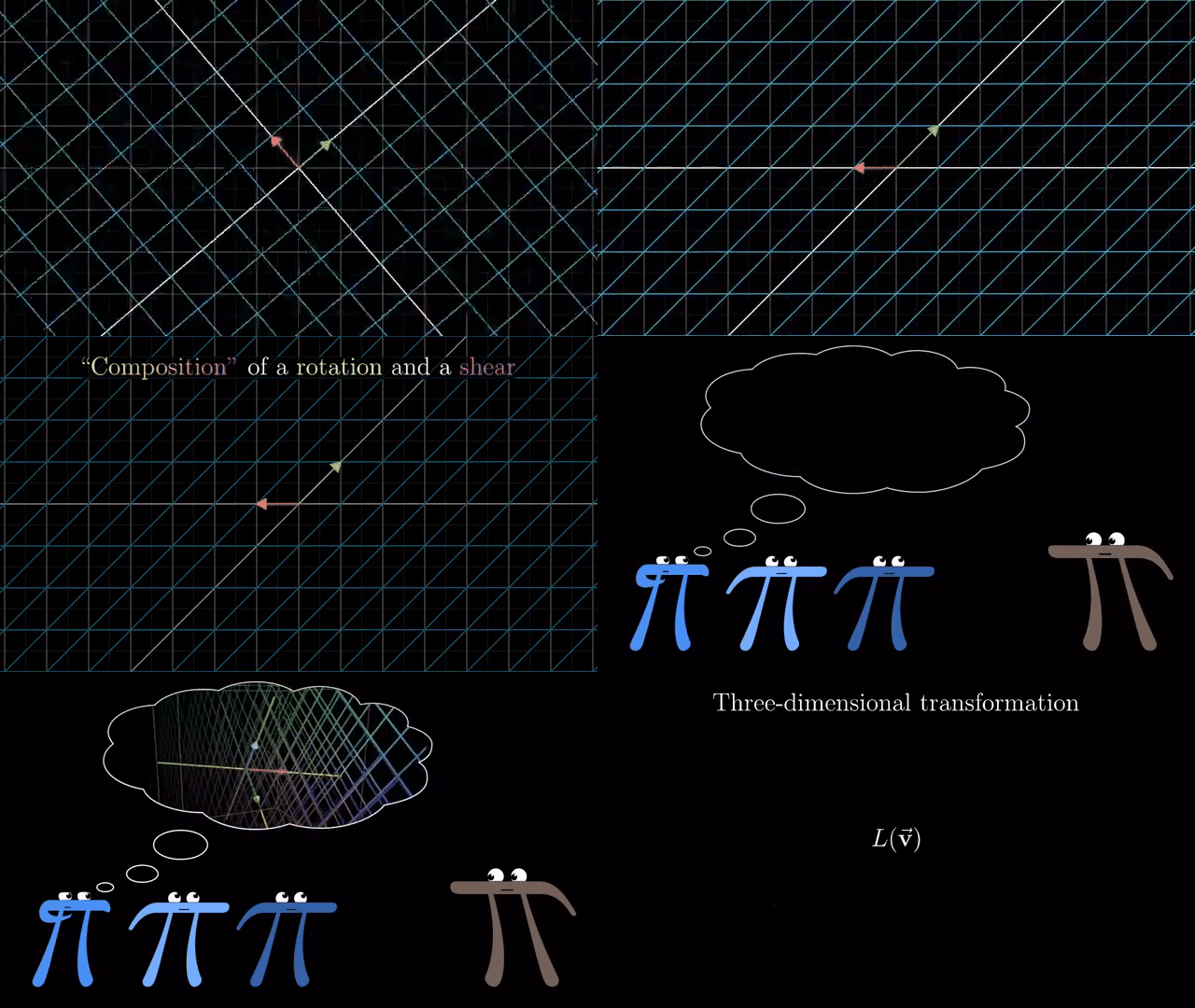
Keep the same mental checklist as in $\mathbb{R}^2$: ask where $\hat{\mathbf{i}}$, $\hat{\mathbf{j}}$, and $\hat{\mathbf{k}}$ land, then read off the $3\times 3$ matrix by columns. Animation pipelines stack many such blocks; the linear heart remains the $3\times 3$ part before translations are added in homogeneous coordinates.
Related cards
Video Content
Tasks
Card Info
- Topic: Mathematics
- Difficulty: Intermediate
- Completed: 0 users
Creator
