Non-commutativity: order usually matters
Even when both $AB$ and $BA$ exist, they often differ. Different pipelines deform space differently . Search for commuting pairs only when symmetry or shared eigen-directions appear.
Two rotations of $\mathbb{R}^2$ about the origin commute because angles add and addition of real numbers commutes. If $AB=I$ for square $A,B$, then $BA=I$ as well: two-sided inverses commute in product to identity.
Nonzero matrices can multiply to zero because each can collapse onto complementary subspaces in sequence. Nullspace interactions create zero products without either factor being zero.
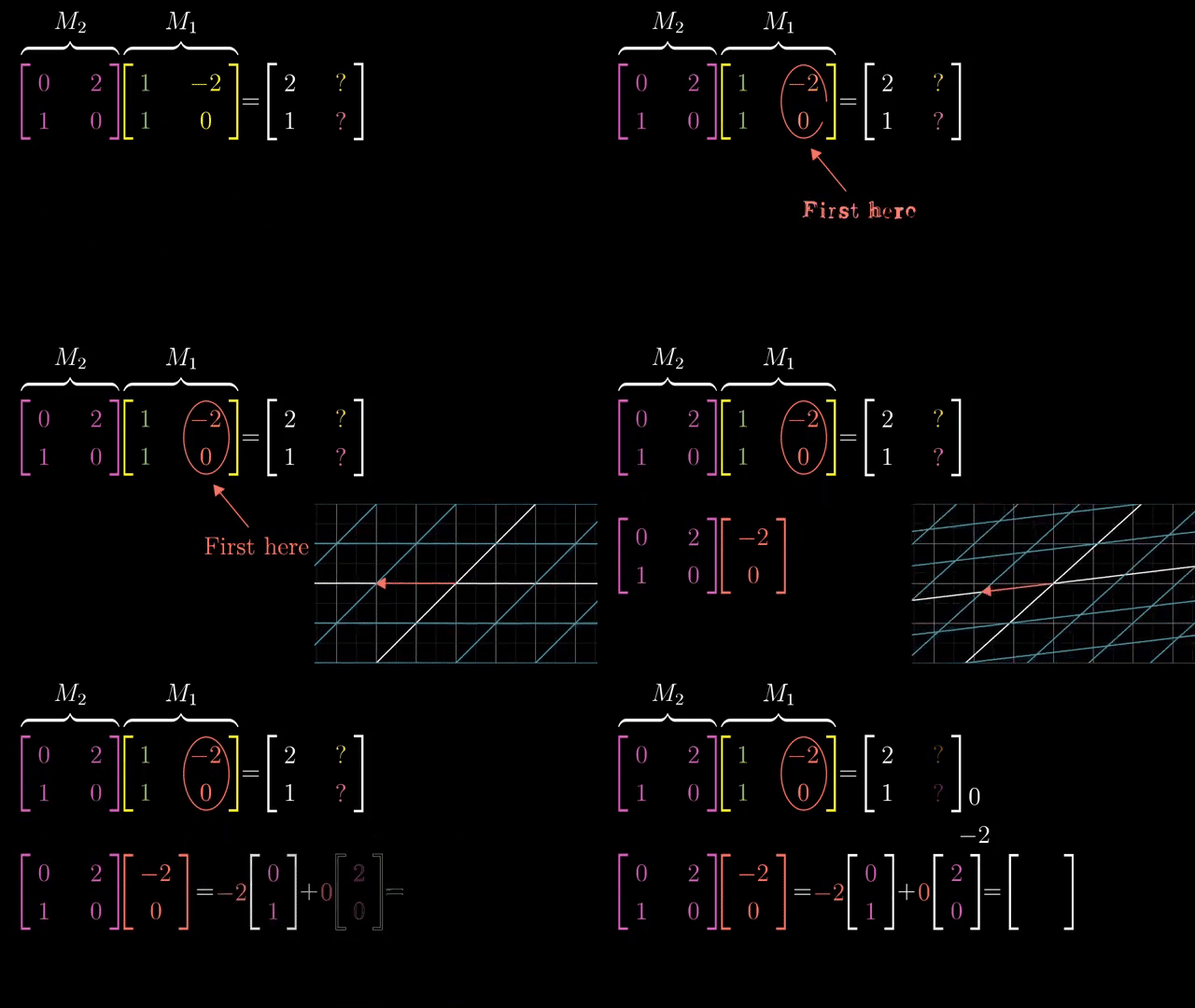
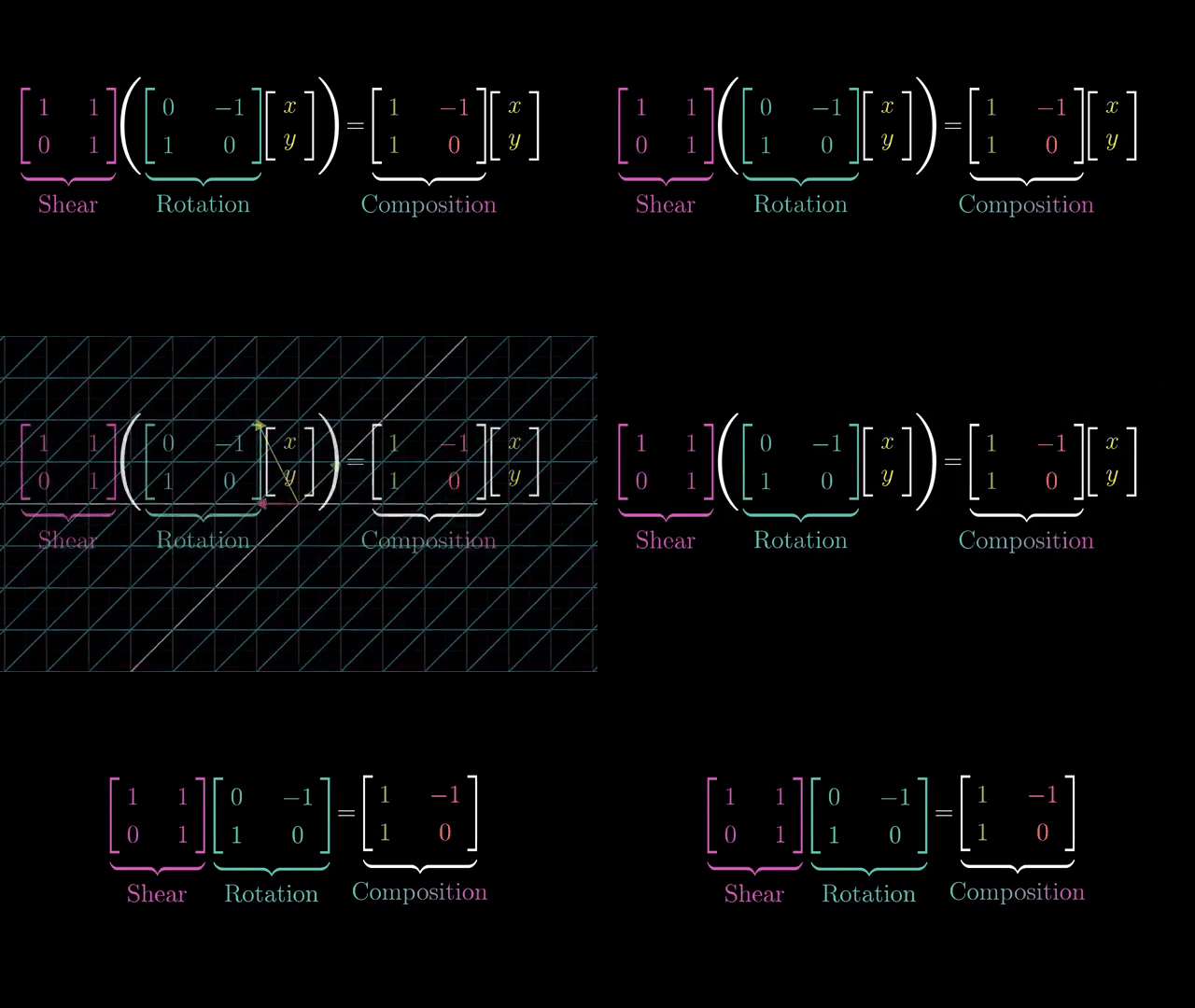
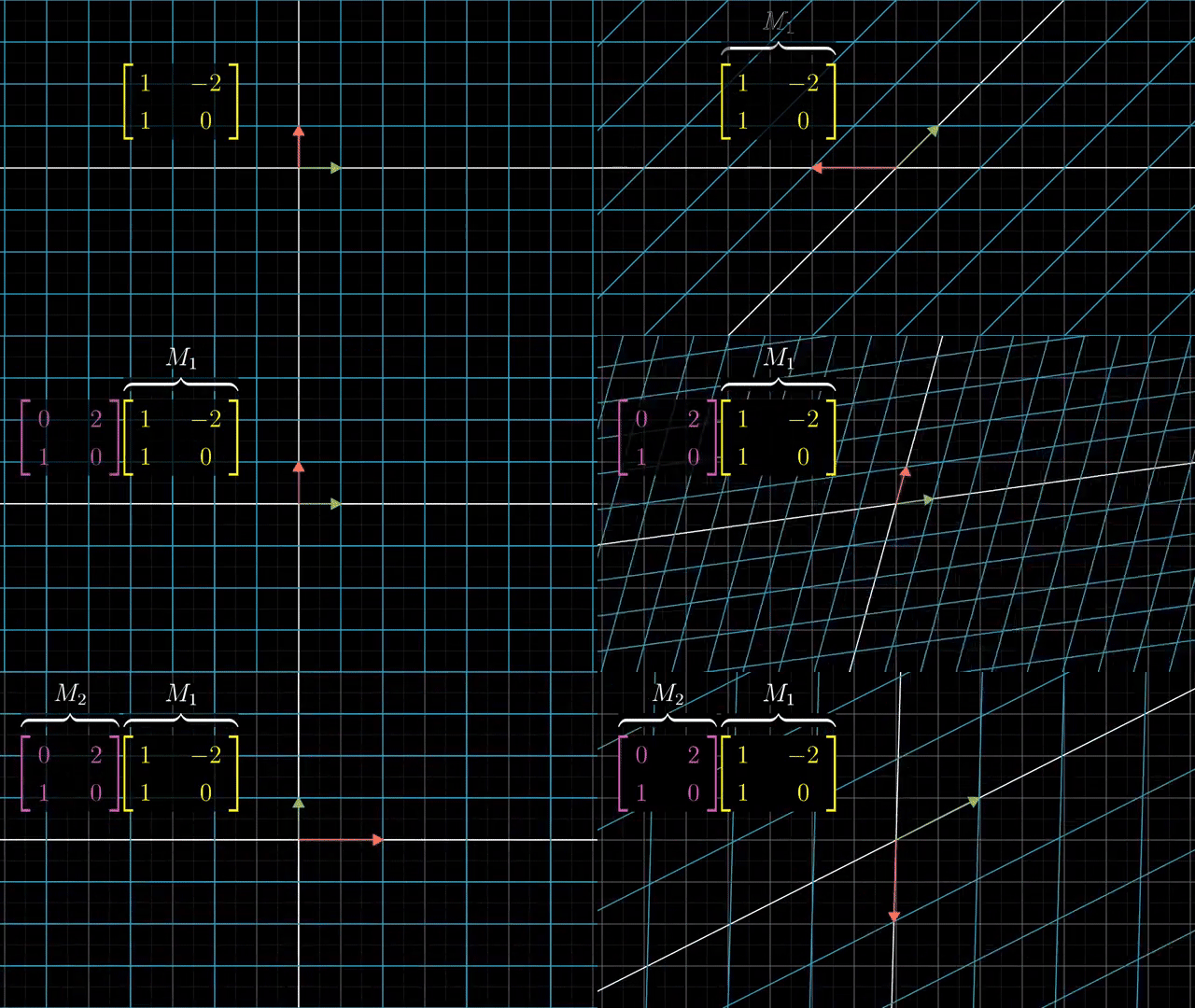
Example: a nonzero shear with rotation off the shear axis typically does not commute. Order changes the composite deformation. $(AB)^2$ is generally different from $A^2B^2$ unless commutation relations let you swap middle factors .
Check your understanding. The tasks below rest on these ideas: Correct: composing rotations adds angles, and addition of reals is commutative. Not quite: matrices generally do not commute, having determinant $1$ does not imply commuting, and rotations are not self-inverse. Correct: for square matrices a one-sided inverse is automatically two-sided, so $BA=I$. Not quite: $A$ and $B$ need not be equal or diagonal, and there is no anticommutation rule. Correct: if the image of one lands in the null space of the other, the composite is zero without either factor being zero. Not quite: zero products force determinant $0$, ranks do not 'add to zero', and the identity never sends things to $\mathbf{0}$. Correct: shear-then-rotate and rotate-then-shear deform space differently, so they fail to commute in general. Not quite: rotations commute with rotations, scalings commute with scalings, and everything commutes with $I$.
Related cards
Video Content
Tasks
Card Info
- Topic: Mathematics
- Difficulty: Beginner
- Completed: 0 users
Creator
