Packing the chapter for matrix multiplication next time
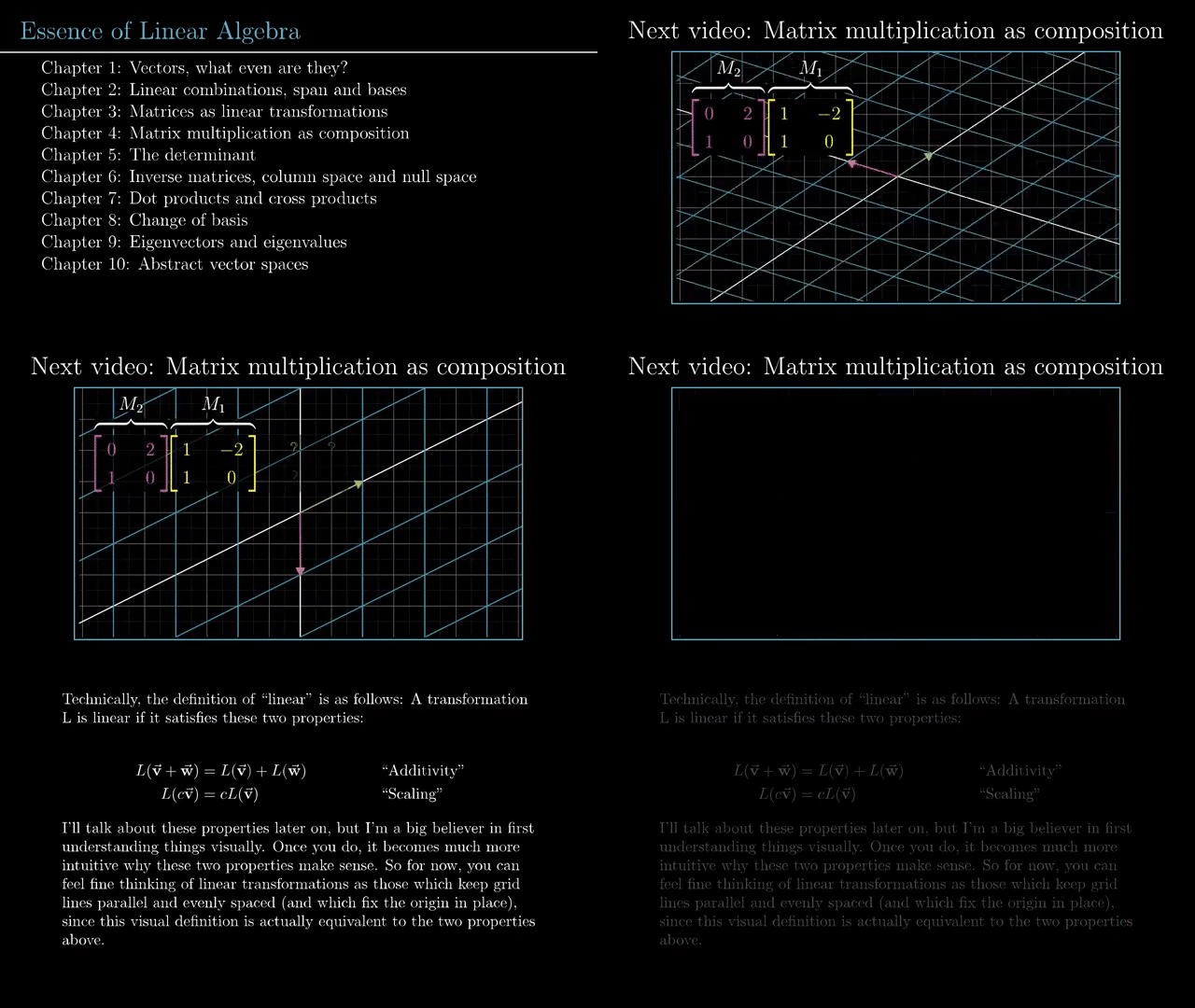
The narrative ends poised for composition: you now read $A\mathbf{x}$ as geometry encoded in columns. The next chapter chains two encodings .
A linear map $\mathbb{R}^2\to\mathbb{R}^3$ is represented by a $3\times 2$ matrix: columns live in codomain $\mathbb{R}^3$ with two input basis directions. Rank can never exceed $\min\{\text{domain dimension},\text{codomain dimension}\}$ for finite spaces.
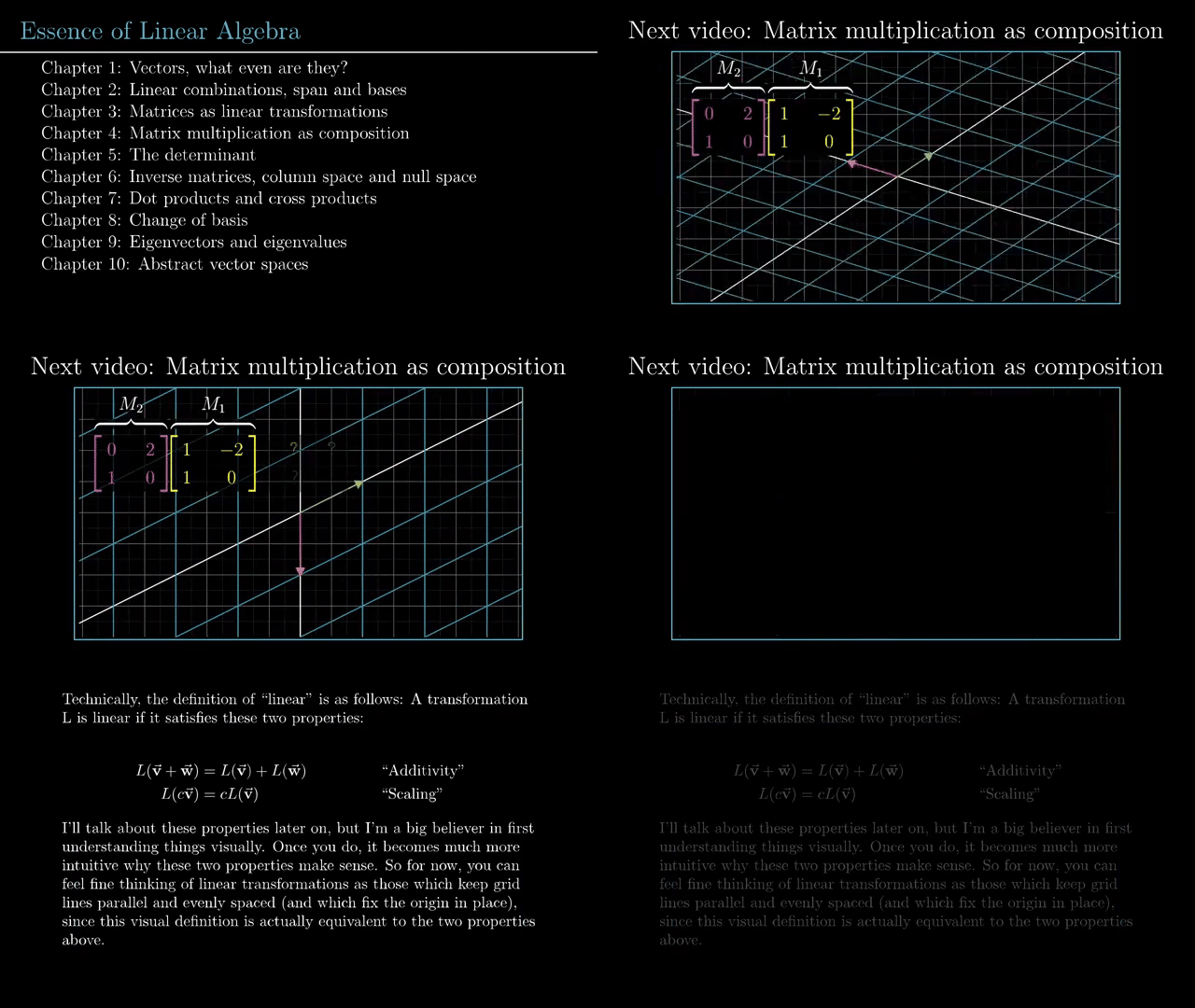
Rectangular matrices move between dimensions; square invertibility is a special subcase. Every linear map must satisfy $T(\mathbf{0})=\mathbf{0}$. That single fact is the quickest linearity sanity check on any candidate transformation.
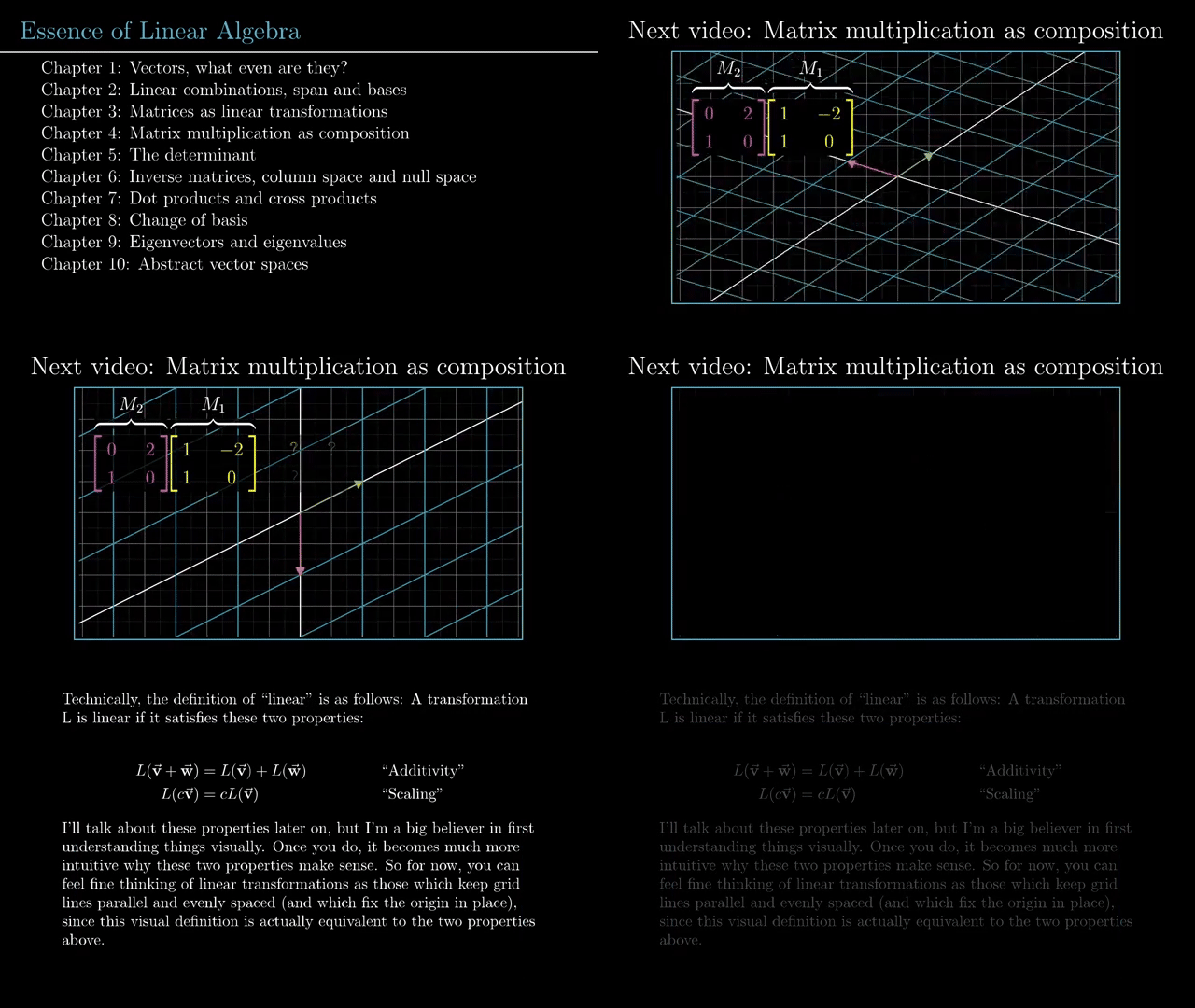
Edge case to carry forward: the same column picture governs composition once you learn to multiply matrices. Order conventions matter, but the destination-arrow reading of columns stays the anchor .
Check your understanding. The tasks below rest on these ideas: Correct: columns live in the codomain $\mathbb{R}^3$ and there is one per input direction, giving $3\times 2$. Not quite: the other shapes swap the dimensions or assume the map is between equal-dimension spaces. Correct: the image cannot have more independent directions than either the inputs allow or the output space can hold. Not quite: bounding by just one of the two, or by their sum, is too loose. Correct: linearity is about preserving sums and scalar multiples, which the polar chart fails to do. Not quite: angles can exceed $\pi$, the radius can be zero, and the issue is structural, not about matrix existence. Correct: setting $c=0$ in $T(c\mathbf{u})=cT(\mathbf{u})$ forces $T(\mathbf{0})=\mathbf{0}$, so failing it rules out linearity instantly. Not quite: distance preservation and circle preservation hold only for special maps, and many linear maps are not invertible.
Related cards
Video Content
Tasks
Card Info
- Topic: Mathematics
- Difficulty: Beginner
- Completed: 0 users
Creator
