Examples: rotation, shear, projection, same rules, different columns
Animations rotate the basis, shear along an axis, or squash onto a line. Each example reads off as two or three column destinations .
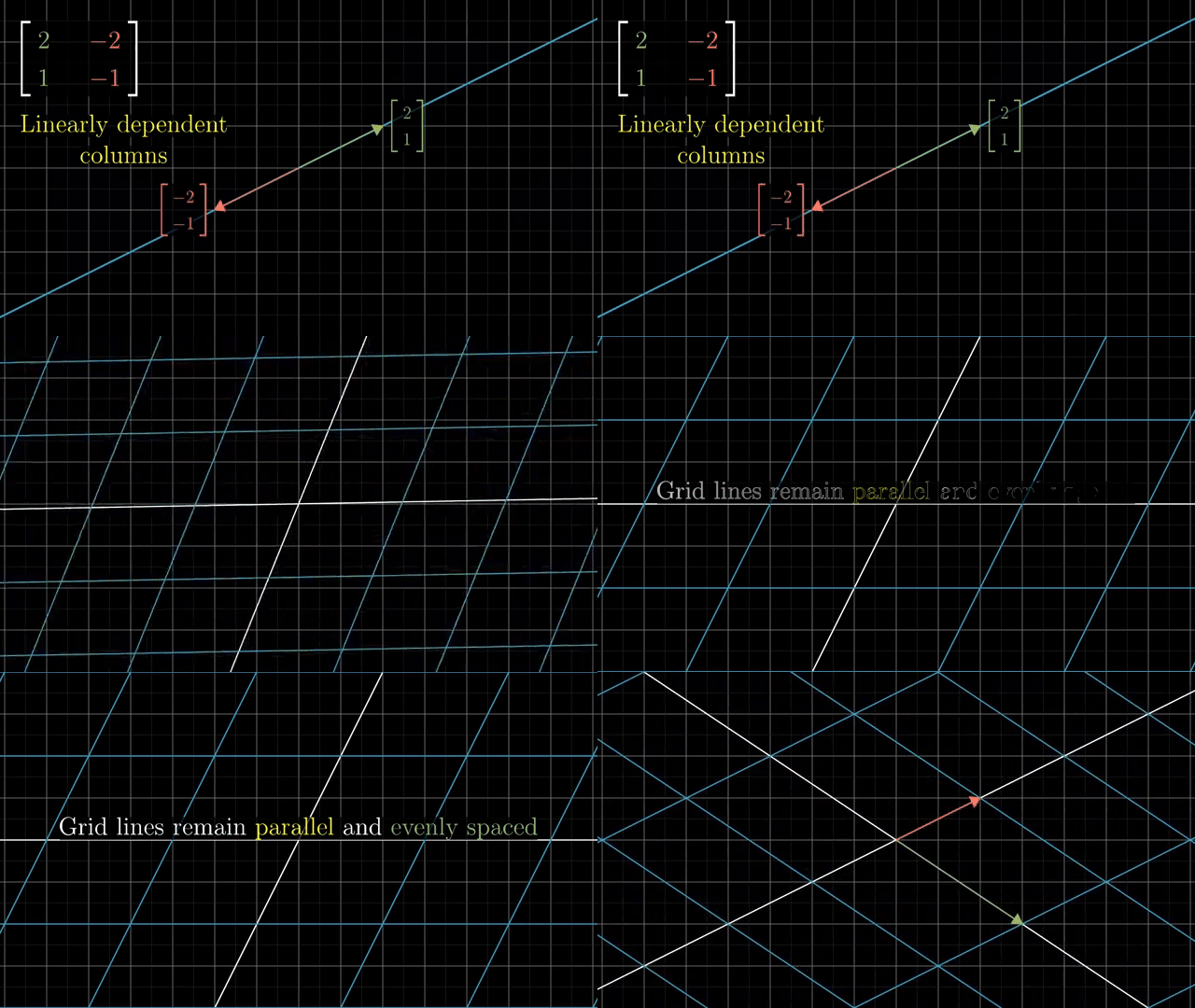
Projection onto the $x$-axis in $\mathbb{R}^2$ sends $\hat{\mathbf{i}}$ to itself and $\hat{\mathbf{j}}$ to $\mathbf{0}$. Rotation by $90^\circ$ counterclockwise maps $\hat{\mathbf{i}}$ to $\hat{\mathbf{j}}$ under the right-hand rule. Shear fixing the $x$-axis moves points vertically by a multiple of their $x$-coordinate.
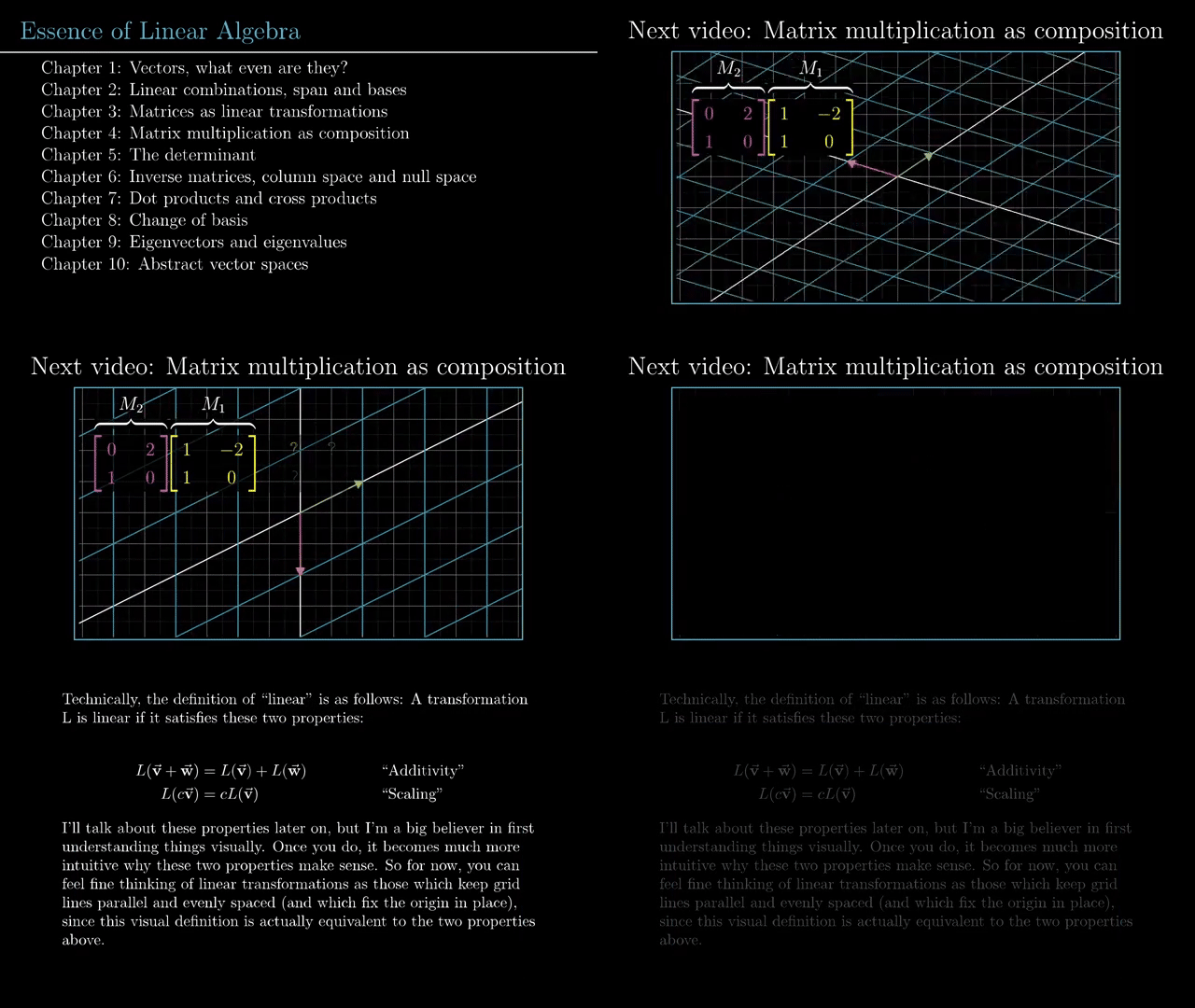
Numerical pitfall: composing maps on paper differs from coding row-major libraries. Keep matrix-vector order consistent with your language. A linear map cannot move every vector by the same nonzero translation because then $\mathbf{0}$ would map away from $\mathbf{0}$.
Each example uses the same rule: record where basis vectors land, then combine columns with input coefficients. Different geometry, same encoding recipe .
Check your understanding. The tasks below rest on these ideas: Correct: $\hat{\mathbf{i}}$ stays put while $\hat{\mathbf{j}}$ collapses to $\mathbf{0}$. Not quite: keeping both basis vectors is the identity, two zero columns is the zero map, and two copies of $\hat{\mathbf{j}}$ is neither. Correct: rotating the rightward unit vector a quarter turn counterclockwise points it up, to $\hat{\mathbf{j}}$. Not quite: $-\hat{\mathbf{i}}$ is a half turn, $-\hat{\mathbf{j}}$ is clockwise, and a rotation never collapses a vector to $\mathbf{0}$. Correct: such a shear adds a vertical offset proportional to $x$, leaving the $x$-axis fixed. Not quite: shears keep lines straight (no circles), affect points off the $y$-axis, and are not radial collapses. Correct: a uniform nonzero shift moves the origin, which linearity forbids. Not quite: such a shift is continuous, preserves dimension, and the restriction is about fixing $\mathbf{0}$, not about allowing only rotations.
Related cards
Video Content
Tasks
Card Info
- Topic: Mathematics
- Difficulty: Beginner
- Completed: 0 users
Creator
