Coordinates as linear combinations of basis arrows
Writing $(x,y)$ as $x\hat{\mathbf{i}}+y\hat{\mathbf{j}}$ reveals the secret grammar: coordinates list the scalars multiplying fixed basis directions. That sentence is the bridge to span, independence, and eventually change of basis .
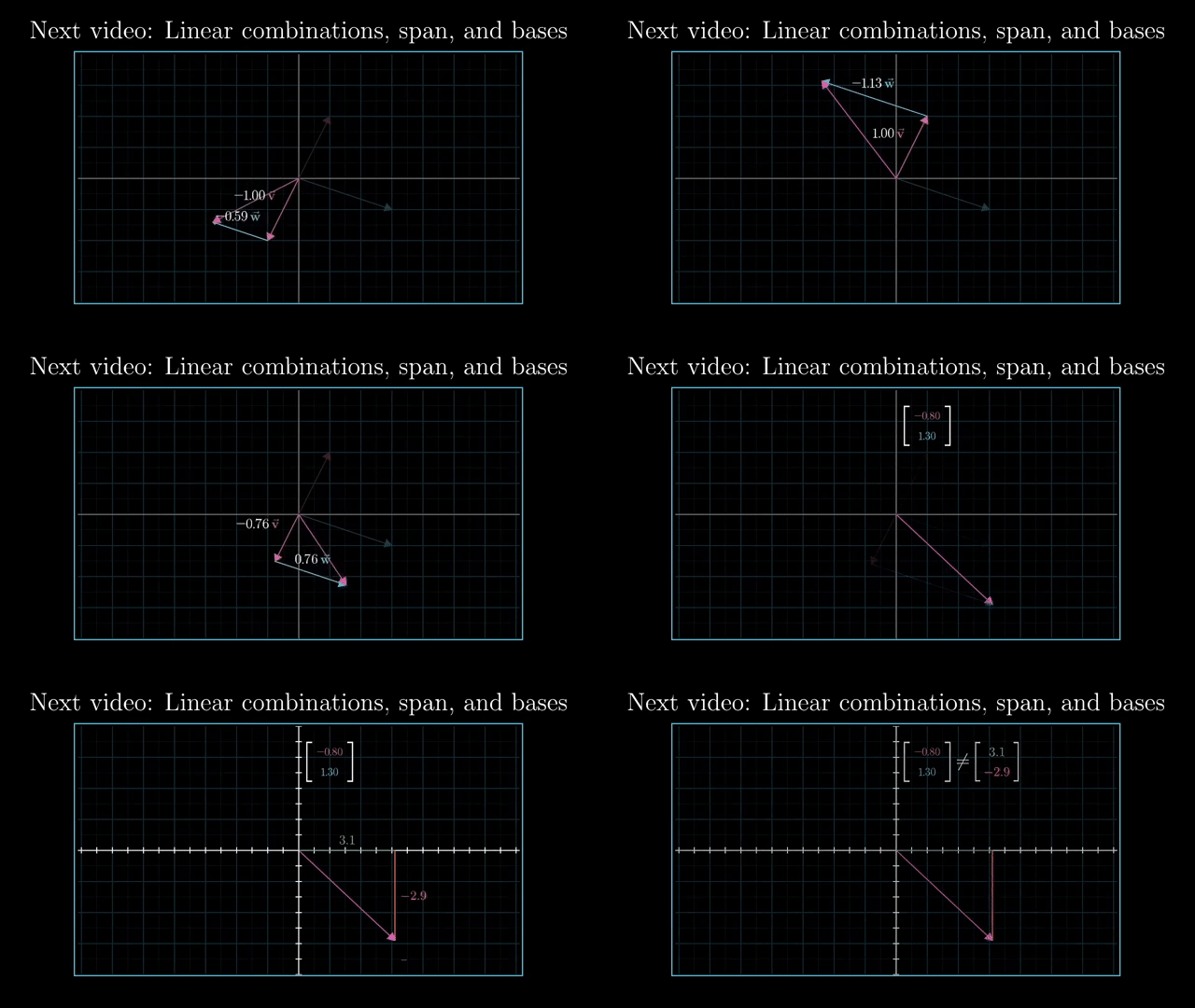
The standard basis $\hat{\mathbf{i}},\hat{\mathbf{j}}$ is one orthonormal spanning pair among infinitely many bases. Any rotation of perpendicular unit axes gives another orthonormal basis of $\mathbb{R}^2$. Oblique coordinate grids are legitimate: the same geometric vectors receive different numeric labels when basis vectors stretch or tilt.
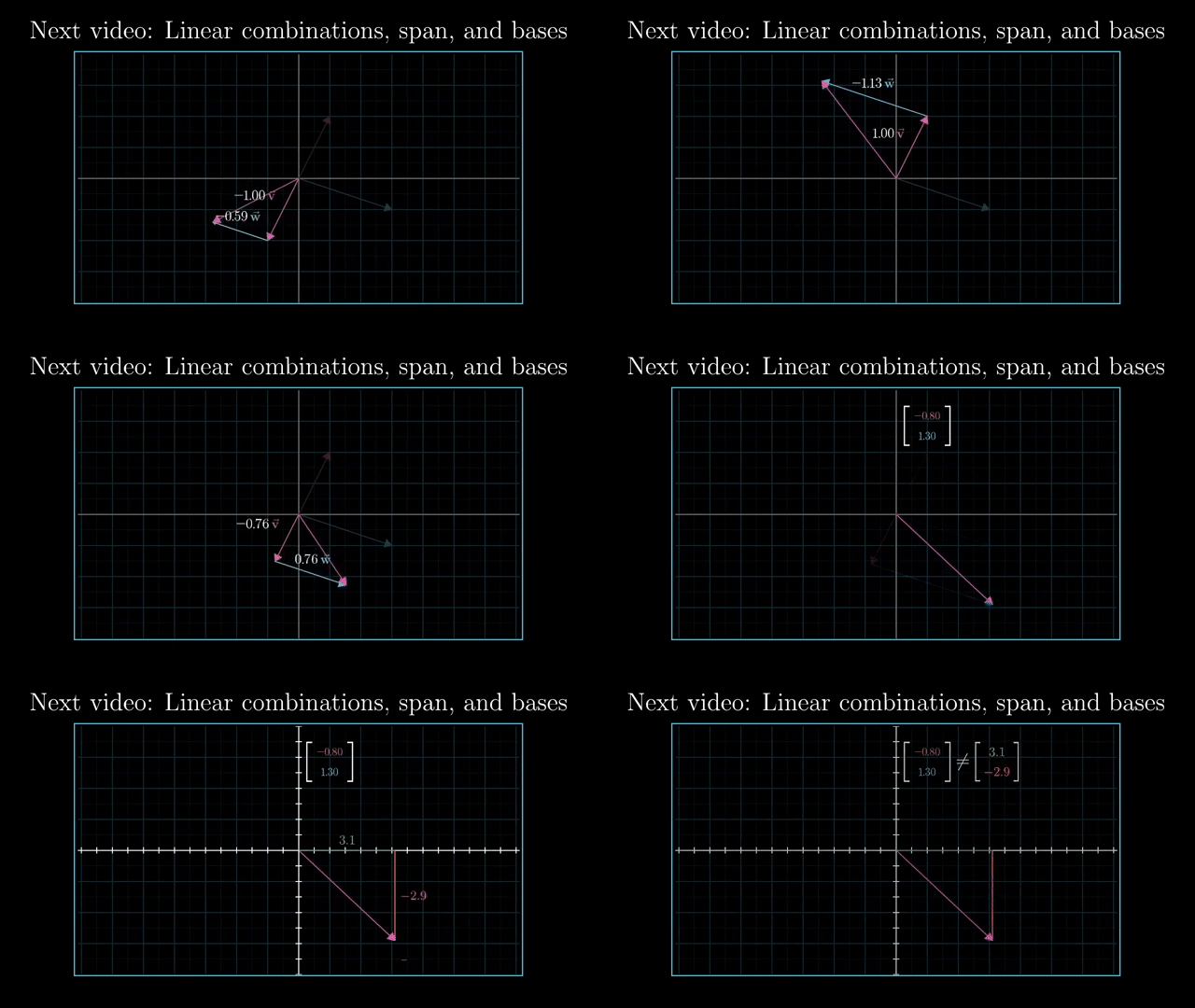
If you replace $\hat{\mathbf{j}}$ by $2\hat{\mathbf{j}}$ but keep arrows geometrically, the same vector usually needs halved $y$-coordinate in the new labeling. Longer basis vectors demand smaller coefficients for the same combination.
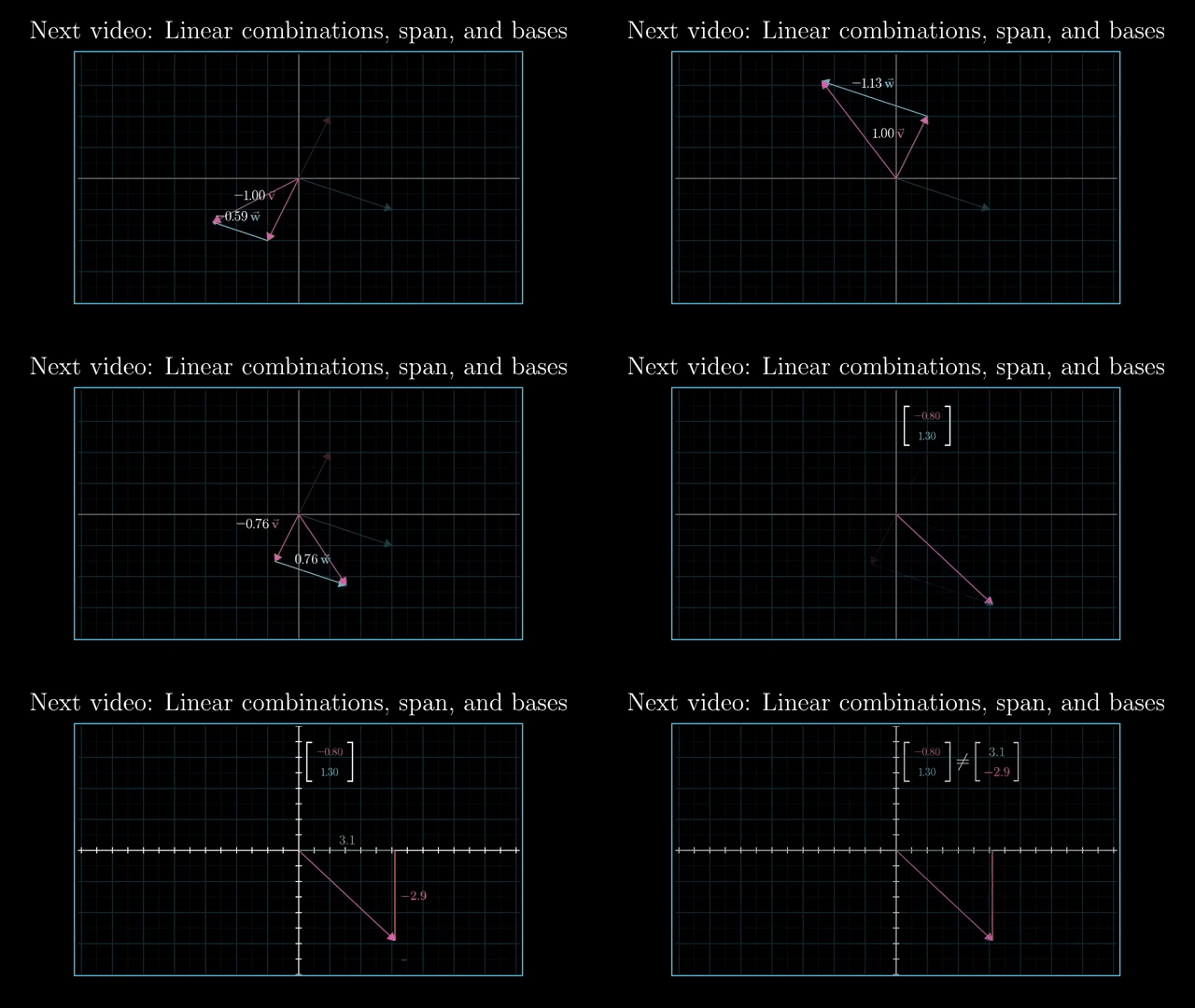
Linear combinations preview: a vector is reachable from $\mathbf{b}_1,\ldots,\mathbf{b}_k$ if it equals $\sum_i c_i \mathbf{b}_i$ for some scalars $c_i$. Chapter 2 makes that reachability language precise as span.
Check your understanding. The tasks below rest on these ideas: Correct: any rotated pair of perpendicular unit vectors is an equally valid basis, so the standard one is convenient but not special. Not quite: many other pairs span $\mathbb{R}^2$, $\hat{\mathbf{i}},\hat{\mathbf{j}}$ are not eigenvectors of an arbitrary matrix, and addition is defined without reference to a chosen basis. Correct: to reach the same point with a basis vector twice as long, you need half as much of it. Not quite: doubling the coefficient would overshoot, the coordinate cannot stay fixed when the basis changes, and relabeling never moves the vector out of the plane. Correct: reachability means $\mathbf{w}$ is a linear combination, i.e. a scaled sum of the generators. Not quite: entrywise products, dot products, and permutations are different operations that do not describe the span. Correct: a rigid rotation of the axes preserves both the unit lengths and the right angle, producing a different orthonormal basis. Not quite: rescaling destroys the unit length, a single vector cannot span the plane, and $\mathbb{R}^2$ has infinitely many bases.
Related cards
Video Content
Tasks
Card Info
- Topic: Mathematics
- Difficulty: Beginner
- Completed: 0 users
Creator
